About Tajuria cippus (Fabricius, 1798)
Scientific name: Tajuria cippus (Fabricius, 1798)
Male description: Upperside is dark cyaneous-blue, and shines blue-green in certain lighting conditions. On the forewing, nearly the apical half is black. There is a narrow black band along the costa that extends to the end of the cell. The inner margin of the apical black band runs almost straight across to a point just above the hinder angle, where the band narrows. All other parts of the wing, including the cell and a narrow basal streak above the sub-costal vein, are blue. The median vein and the base of its branch are black.
On the male hindwing, the costal band is broadly black. The outer marginal line is finely black, the sub-costal vein is black, and the abdominal fold is blackish brown. There is a black spot at the anal angle, covered with some pale bluish-white scales. Tails are black, with white tips. The cilia of both wings are black, with pale tips.
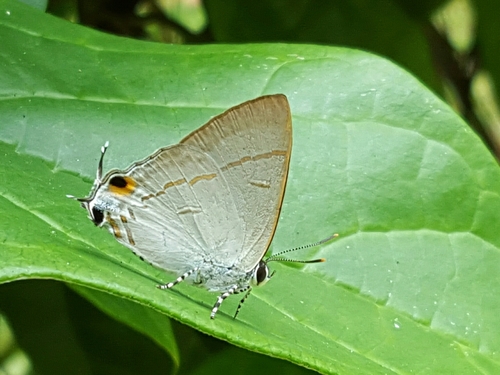
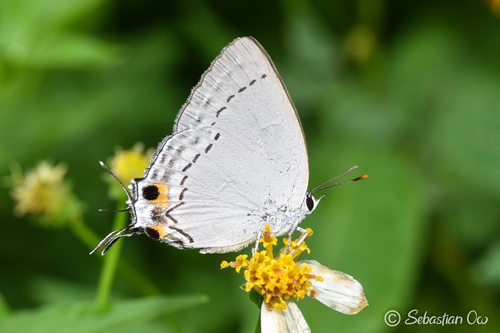
The underside is grey. The forewing occasionally has a discal series of faint, thin black lunules, but these markings are absent in most individuals, leaving the wing with no visible markings. On the male hindwing, there is a regular discal series of similar markings, which sit closer to the margin than is typical. The upper markings of this series are more or less linear and clearly separated from each other; the last two markings are curved and turn inward onto the abdominal margin just above the anal angle. There is a sub-marginal pale grey band, and a second, even paler, narrower band that lies close to the margin. There is a black anal spot, with a small white spot on each side of its upper section. A second, larger black spot sits in the first interspace, capped with orange. The space between these two spots is pale bluish-white, with a few dark blue scales inside. The terminal line of both wings is dark brown.
Antennae are black, ringed with white, and the club has a red tip. The frons is white, with a black central stripe. Eyes are ringed with white. The head and body, both above and below, match the color of the wings.
Female description: Upperside is pale greyish-blue. The forewing is darker toward the base, with a small number of brighter blue scales. The marginal bands are blackish-brown, broader on the costa, but narrower at the apex than they are in the male. The hindwing is generally darker than the forewing, and its bands are paler. The costal band is broader than it is in the male, with its lower section darker than its upper section. The outer marginal band is broader and macular. There is a fairly prominent discal band of somewhat lunular markings, which curves evenly, though the individual marks are arranged in echelon relative to each other. The underside matches that of the male, but the discal series of markings on both wings is almost always present.