About Tagiades japetus (Stoll, 1781)
Scientific name: Tagiades japetus (Stoll, 1781)
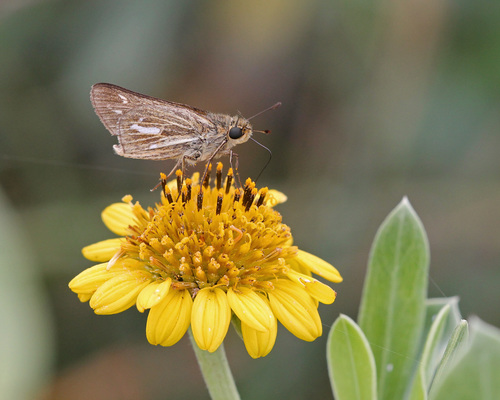
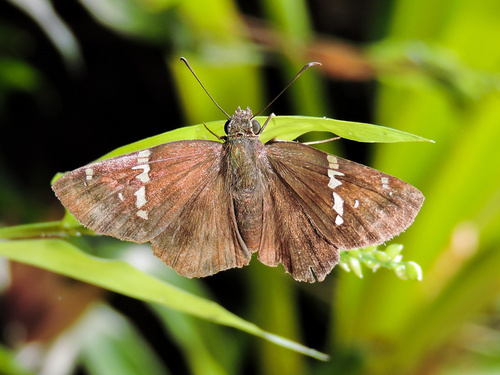
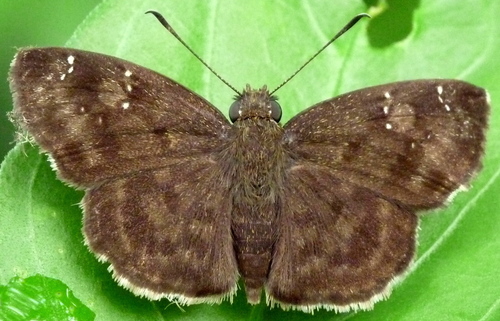
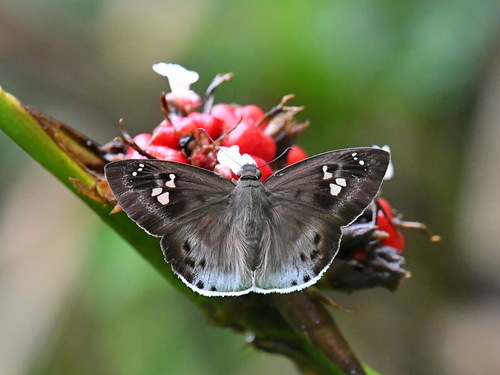
Male description: On the upperside, the color is fuliginous-brown. The forewing has three tiny subapical white dots; one, or sometimes two, of these dots are often absent. There is an additional tiny dot at the end of the cell, another near the base of the second median interspace, and a third below this dot in the middle of the first median interspace; sometimes only one or two of these dots are present, and sometimes all are absent. The hindwing has faint markings of a curved discal series of spots that are darker than the base wing color, and these spots are often completely invisible. The cilia of both wings are brown.
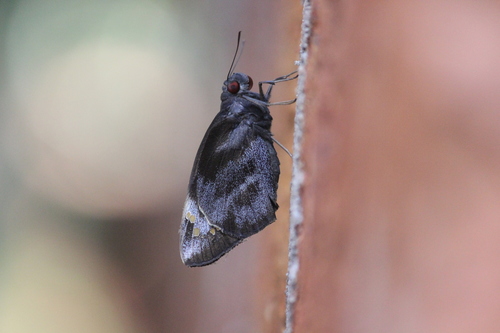
On the underside, the forewing is paler than it is on the upperside; the hind marginal area and a broad squarish patch at the hinder angle are paler than the rest of the wing, and the tiny dots match the pattern seen on the upperside. The hindwing is greyish-white, with the costal and outer marginal areas somewhat suffused with brown; it has a curved series of dark brown discal spots, and the lower spots are usually only small dots that are often invisible.
Female description: The upperside is colored the same as the male, but the shade of color is more variable between different individuals of this sex than it is in males. The subapical dots are often larger (though not always), and are generally three in number. The discal spots are much larger: the spot at the end of the cell is round, the outer spot near the base of the second median interspace is usually conical, the spot below it is the largest and quadrate, and two small spots lie between this large spot and the hinder margin. The hindwing has an obscure blackish spot at the end of the cell and a discal series of spots, all of which are very indistinct in many examples.
On the underside, the forewing is somewhat paler than the upperside, with similar markings. The hindwing is usually much darker grey, sometimes blue-grey, with a small black dot at the end of the cell. In some examples there is a complete, irregular discal series of black spots, but these spots vary greatly in how prominent they are, and in many examples they are no more visible than they are in males. The head and body on the upperside match the color of the wings; the palpi and lower body match the color of the hindwing.
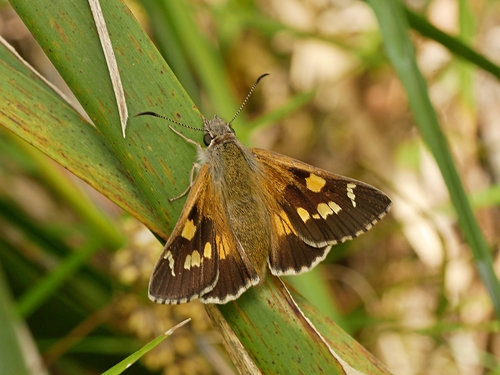
Distribution and habitat: Tagiades japetus has a wide range of occurrence. It is found from Sri Lanka and India to the Himalayas and Indochina. It also occurs across Maritime Southeast Asia to the Philippines, extending south to Papua New Guinea, its surrounding islands, and northeastern Australia. It is commonly found at the edges of rainforests and vine thickets, and sometimes occurs in cultivated lands.
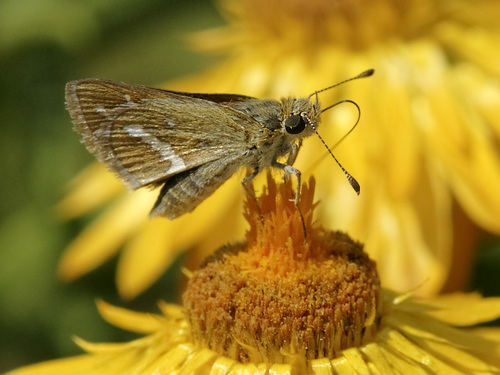
Life cycle and ecology: Eggs are laid on the upper surface of young leaves. They hatch after approximately six days, after which larvae construct a leaf shelter by cutting the edge of a leaf, folding a triangular section back, and attaching it with silk. During the day, larvae hide in this shelter and only emerge to feed at night. Larvae feed on leaves of vines in the genus Dioscorea, including Dioscorea transversa, Dioscorea alata, and Dioscorea numularia. Larvae may build new shelters as they grow larger. After approximately 23 days, larvae pupate inside their final shelter, and emerge as adults after 10 days. Adults are fast fliers that fly relatively close to the ground, generally under large trees, and often rest under leaves. They are most commonly encountered resting on the undersides of leaf surfaces. They feed on flower nectar during the morning. Mating occurs year-round, and adults emerge throughout the year, though populations reach their highest size during the wet season.