About Tagetes erecta L.
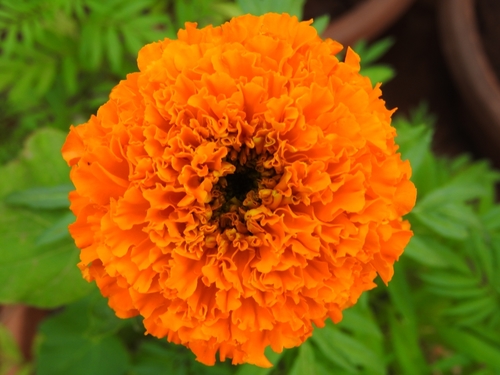
Tagetes erecta L. is an herbaceous plant that can be either annual or perennial, growing between 30 and 110 cm tall. It has a cylindrical taproot with a shallow, fibrous branching system. Its stem is striated, sometimes ridged, and can be smooth or slightly hairy; it is cylindrical to oval, herbaceous to slightly woody, and contains resin canals in the bark that release an aromatic scent when squeezed. Leaves are arranged oppositely on the lower stem and alternately on the upper stem, growing up to 20 cm long. They are pinnate, made up of 11 to 17 leaflets that are lanceolate to linear-lanceolate, up to 5 cm long and 1.5 cm wide, with an acute to acuminate tip and serrated margins. The lower leaflets of each leaf are often thread-like (setiform), and the upper leaflets are sometimes fully setiform; leaves also have numerous round glands. Flowers are grouped in small heads or borne as solitary inflorescences on peduncles up to 15 cm long, with ray florets ranging in color from yellow to red. Disc florets number 150 to 250 in single flower heads; in double flower heads, they show varying degrees of transformation into ray florets, with yellow to orange corollas 8 to 10 mm long. The fruits are linear achenes holding seeds, measuring 7 to 10 mm long, and are smooth or lightly covered in stiff hairs at the corners. This species has a long flowering period that lasts all through summer and fall, and it reproduces easily from seed. Although native to Mexico, it is also found across Central America and the Caribbean, specifically in Belize, Bolivia, Colombia, Costa Rica, Cuba, Ecuador, El Salvador, Guatemala, Guyana, Honduras, Jamaica, Nicaragua, Panama, Puerto Rico, and Venezuela. Wild populations grow in the Balsas basin and western Mexico, where they occur in a variety of ecosystem types including tropical deciduous forest, thorny forest, cloud forest, and pine-oak forest. In the wild, it grows as an escape in heavily disturbed sites at elevations between 800 and 2300 m. It is found as an introduced cultivated species in China, India, Zambia, Zimbabwe, South Africa, and Australia. Tagetes erecta L. is widely cultivated, with many cultivars grown as ornamental garden plants. The cultivar 'Inca Orange' has received the Royal Horticultural Society's Award of Garden Merit. In Mexico, it is used to decorate altars and tombs during Day of the Dead festivities, which gives it the common name "flower of the dead". It has also been used for food and medicinal purposes since ancient times. It has been used for medicinal purposes since pre-Hispanic times in Mexico. The Cherokee people used it as a skin wash and to produce yellow dye. The pigments in Tagetes erecta come from carotenoids, the most abundant of which is lutein, a compound linked to the prevention of age-related eye conditions including cataracts and macular degeneration. More intense orange flower color corresponds to higher carotenoid content, especially of xanthophyll. Some studies indicate xanthophyll is effective for preventing coronary artery disease and heart attacks, and supporting immune response, healthy aging, and cancer prevention. In some regions of Mexico, it is used to treat digestive complaints including stomach pain, diarrhea, colic, liver problems, bile disorders, vomiting, and indigestion. The plant also has a history of use against intestinal parasites and worms; one study found it acts through a different mechanism than the anthelmintic drug levamisole. Other traditional medicinal uses include treating respiratory conditions such as colds, flu, bronchitis, and nasal congestion, as well as gynecological problems. Antioxidant activity has been identified in the essential oil of this plant, although it is lower than the antioxidant activity of α-Tocopherol; this activity may come from the camphor and methyl eugenol present in the oil. It is most effective against the nematode species Pratylenchus penetrans.