About Taeniurops meyeni (Müller & Henle, 1841)
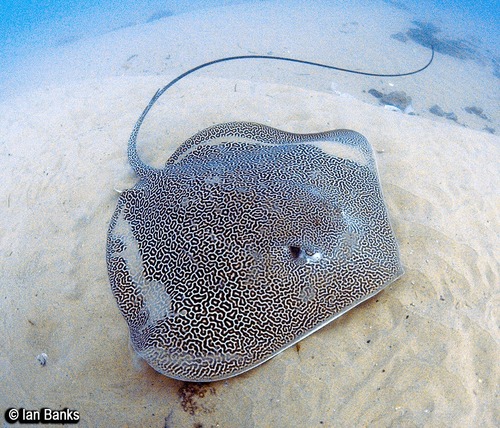
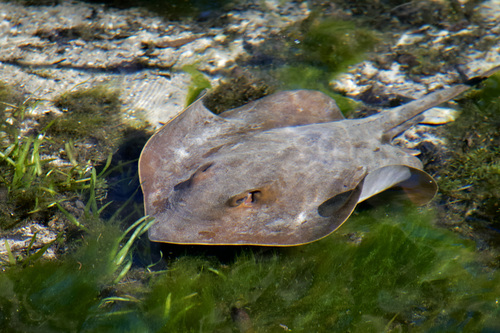
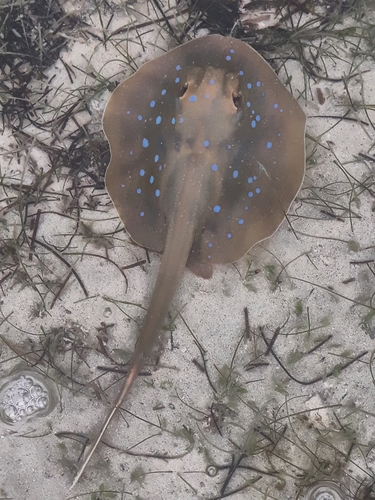
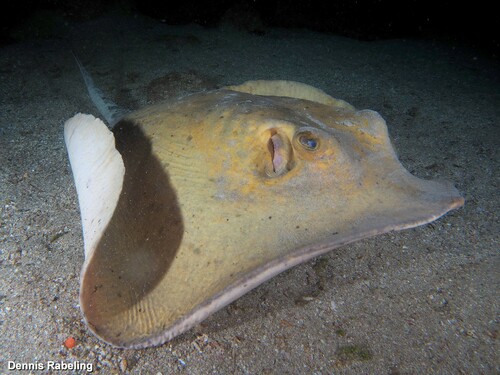
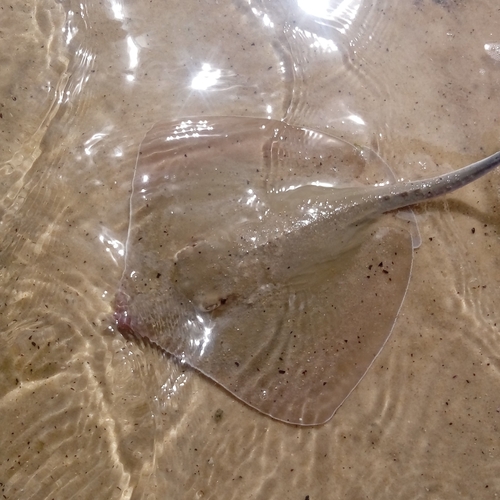
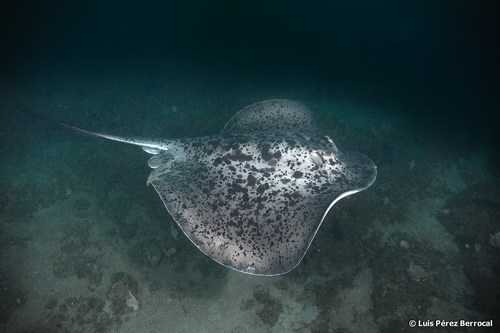
Scientific name: Taeniurops meyeni (Müller & Henle, 1841). The round ribbontail ray has a thick pectoral fin disc that is wider than it is long, with a smoothly rounded outer margin. Its eyes are medium-sized, and larger spiracles sit directly behind the eyes. Between the oval nostrils, there is a short, broad curtain of skin with a finely fringed trailing edge. The mouth is wide and curved, with faint furrows at the corners. A row of seven papillae runs along the floor of the mouth; the outermost pair of papillae are smaller and set apart from the other five. There are 37 to 46 tooth rows in the upper jaw, and 39 to 45 tooth rows in the lower jaw. The teeth are small, with a deep groove across the crown, and arranged in a dense quincunx pattern to form flattened surfaces. The pelvic fins are small and narrow. The tail is relatively short, and does not exceed the width of the disc. It bears one long, serrated stinging spine on the upper surface; two spines are rare. The base of the tail is broad; past the spine, the tail narrows rapidly, and carries a deep ventral fin fold that runs all the way to the tail tip. The upper surface of both the disc and tail is roughened by a uniform covering of small, widely spaced granules. There is also a midline row of sharp tubercles on the back, with two shorter rows of tubercles running alongside. The first of these tubercles develop when the ray reaches around 46 cm (18 in) long, forming over the "shoulders" and within the single midline row. The dorsal coloration of the round ribbontail ray ranges from light to dark gray, brown-gray, or purplish, becoming most intense toward the fin margins. It has a highly variable pattern of irregular darker mottling, plus white speckles or streaks. The portion of the tail past the spine, including the fin fold, is uniformly black, while the underside is creamy-white with darker fin margins and extra dark dots. Young round ribbontail rays have plainer coloration than adult individuals. This is one of the largest stingray species, and can grow to 1.8 m (5.9 ft) across the disc, 3.3 m (11 ft) in total length, and 150 kg (330 lb) in weight. This ray has a wide distribution across the Indo-Pacific region. It is found from KwaZulu-Natal in South Africa northward along the East African coast to the Red Sea, including Madagascar and the Mascarenes. From there, its range extends eastward past the Indian subcontinent to Southeast Asia and Micronesia, occurring as far north as Korea and southern Japan, and as far south as Australia. In Australia, it occurs from at least Ningaloo Reef off Western Australia to Stradbroke Island off Queensland, including Lord Howe Island. In the easternmost part of its range, it has been reported from Cocos Island and the Galápagos Islands, and individual rays may disperse as far as Central America. The round ribbontail ray is a bottom-dwelling species. It is typically found close to shore at depths of 20 to 60 m (66–197 ft), though it has been reported anywhere from the surf zone down to a depth of 439 m (1,440 ft). It favors sand or rubble bottoms in shallow lagoons or near coral and rocky reefs, and may also enter estuaries. The round ribbontail ray is nocturnal, and rests motionless for most of the day, often near vertical structures, in caves, or under ledges. It may be solitary, or form small to large groups. This ray is frequently shadowed by one or more jacks or cobia (Rachycentron canadum); these smaller fishes may feed on food stirred up by the ray's activities, or use the ray's body as cover while approaching their own prey. The round ribbontail ray hunts bivalves, crabs, shrimps, and small bony fishes on the seabed. When feeding, it uses a characteristic posture: it presses the edge of its disc against the bottom, takes in water through its spiracles, and blows the water out through its mouth to uncover prey buried in the sediment. This species may be preyed on by larger fishes such as sharks, and by marine mammals. When threatened, it lifts its tail over its back to point the stinging spine forward, and waves the tail back and forth. Documented parasites of the round ribbontail ray include the monogeneans Dasybatotrema spinosum, Dendromonocotyle pipinna, Neoentobdella garneri and N. taiwanensis, and the nematode Echinocephalus overstreeti. Very little information is available about the life history of this species. Like other stingrays, the round ribbontail ray is aplacental viviparous: unborn embryos are initially sustained by yolk, which is later supplemented by histotroph (called "uterine milk", which contains proteins, lipids, and mucus) produced by the mother. Reproductive aggregations numbering in the hundreds have been observed at Cocos Island shortly after La Niña begins, which brings cooler water temperatures to the area. During these aggregations, a single female may be pursued by dozens of males. Females give birth to litters of up to seven pups. Each pup measures 33–35 cm (13–14 in) across the disc and 67 cm (26 in) long. Off the coast of South Africa, birthing likely takes place in the summer. Males reach sexual maturity when their disc width is 1.0–1.1 m (3.3–3.6 ft); the disc width at which females reach sexual maturity is unknown.