About Taeniura lymma (Forsskål, 1775)
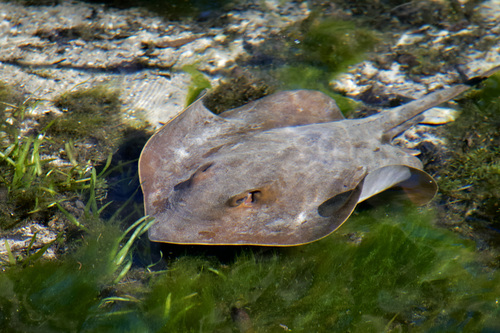
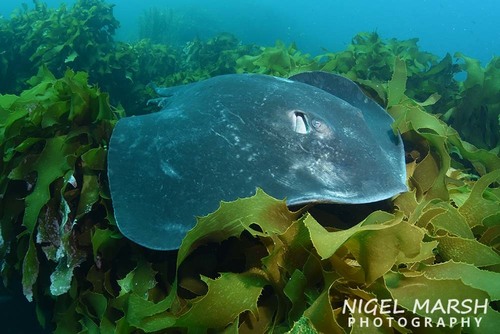
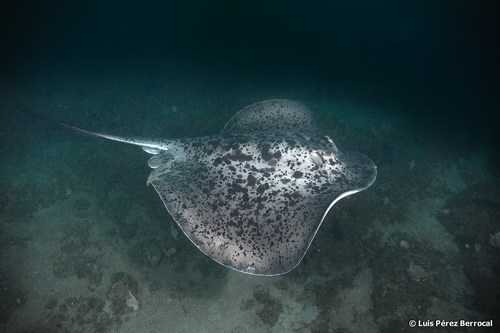
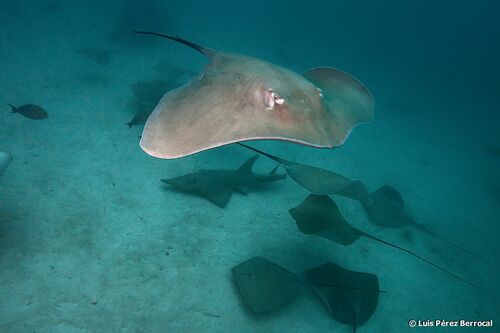
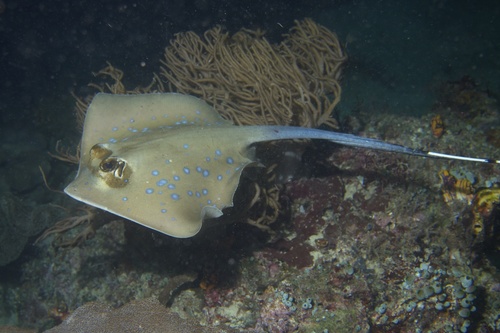
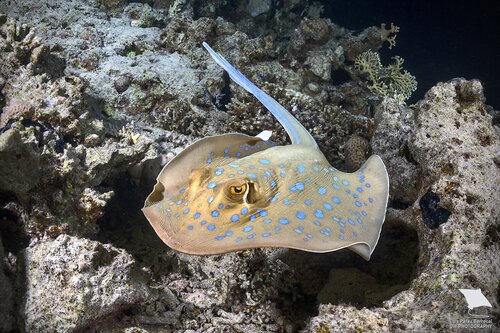
Scientific name: Taeniura lymma (Forsskål, 1775), common name bluespotted ribbontail ray. The pectoral fin disc of this ray is oval, around four-fifths as wide as it is long, with a snout that ranges from rounded to broadly angular. Large, protruding eyes are immediately followed by broad spiracles. A narrow flap of skin with a fringed posterior edge sits between the nares, and extends past the mouth. The lower jaw dips inward at its midpoint, and deep furrows are present at the corners of the mouth. Both jaws hold 15–24 tooth rows, arranged into pavement-like plates, and two large papillae are found on the floor of the mouth. Pelvic fins are narrow and angular. The thick, flattened tail measures approximately 1.5 times the length of the disc, and carries one or two (most often two) serrated spines located well behind the tail base. A deep fin fold runs along the ventral surface of the tail all the way to the tip, and a low midline ridge is present on the upper surface. The skin is generally smooth, with the possible exception of a scattering of small thorns along the middle of the back. Its dorsal coloration is distinct: it has numerous circular, neon blue spots scattered over a yellowish brown or green background. The spots vary in size, growing smaller and denser closer to the margin of the disc. The tail has two stripes of the same blue running along each side as far as the spines; individuals found off southern Africa may lack these blue tail stripes. The eyes are bright yellow, and the belly is white. This species grows to 35 cm (14 in) across the disc, 80 cm (31 in) in total length, and up to 5 kg (11 lb) in weight. The bluespotted ribbontail ray is widespread in the nearshore tropical waters of the Indo-Pacific region. Its range extends along the periphery of the Indian Ocean from South Africa to the Arabian Peninsula to Southeast Asia, including the islands of Madagascar, Mauritius, Zanzibar, and the Seychelles, plus Sri Lanka and the Maldives. It is rare in the Persian Gulf and Gulf of Oman. In the Pacific Ocean, it is found from the Philippines to northern Australia, and around many Melanesian and Polynesian islands as far east as the Solomon Islands. This bottom-dwelling species is rarely found deeper than 30 m (100 ft), and most often frequents coral reefs and adjacent sandy flats. It is also commonly found in the intertidal zone and tidal pools, and has been seen near seagrass beds. Every summer, large numbers of this ray arrive in waters off South Africa. This is one of the most abundant stingray species living on Indo-Pacific reefs. During the day, individuals generally hide alone inside caves, under coral ledges, or under other debris including shipwrecks, often with only their tail visible. At night, small groups gather and swim onto shallow sandy flats with the rising tide to feed. Unlike many other stingrays, this species rarely buries itself in sand. It excavates sand pits to search for its prey, which includes molluscs, polychaete worms, shrimps, crabs, and small benthic bony fishes. When prey is found, the ray traps it with its body and maneuvers it into the mouth using its disc. Other fish, such as goatfish, often follow foraging rays to feed on prey the ray has missed. Breeding takes place from late spring to summer. A male will follow a female and nip at her disc, eventually biting and holding onto her for copulation. One documented case recorded a male holding onto the disc of a smaller male Kuhl's stingray (Neotrygon kuhlii), which may be a case of mistaken identity. Adult males have been observed gathering in shallow water, an activity that may be connected to reproduction. Like other stingrays, the bluespotted ribbontail ray is aplacental viviparous. Embryos are initially sustained by yolk; later in development, the mother supplements this nutrition with histotroph, also called "uterine milk", which contains mucus, fat, and proteins. The length of the gestation period is not certain, but is estimated to be between four and twelve months. Females give birth to litters of up to seven young; each pup is a miniature version of the adult, measuring around 13–14 cm (5.1–5.5 in) across the disc. Males reach sexual maturity at a disc width of 20–21 cm (7.9–8.3 in); the size at which females reach sexual maturity is unknown. Known predators of the bluespotted ribbontail ray include hammerhead sharks (genus Sphyrna) and bottlenose dolphins (genus Tursiops); it may also be preyed on by other large fishes and marine mammals. When threatened, this ray typically flees at high speed in a zigzag pattern to confuse pursuers. Many different parasites have been identified from this species: tapeworms include Aberrapex manjajiae, Anthobothrium taeniuri, Cephalobothrium taeniurai, Echinobothrium elegans, E. helmymohamedi, Kotorelliella jonesi, Polypocephalus saoudi, Rhinebothrium ghardaguensis and R. taeniuri; monogeneans include Decacotyle lymmae, Empruthotrema quindecima, Entobdella australis, and Pseudohexabothrium taeniurae; flatworms include Pedunculacetabulum ghardaguensis and Anaporrhutum albidum; the nematode Mawsonascaris australis, the copepod Sheina orri, and the protozoan Trypanosoma taeniurae have also been recorded. This ray has been observed soliciting cleaning from bluestreak cleaner wrasse (Labroides dimidiatus) by raising the margins of its disc and pelvic fins.