About Taeniura grabata (Geoffroy Saint-Hilaire, 1817)
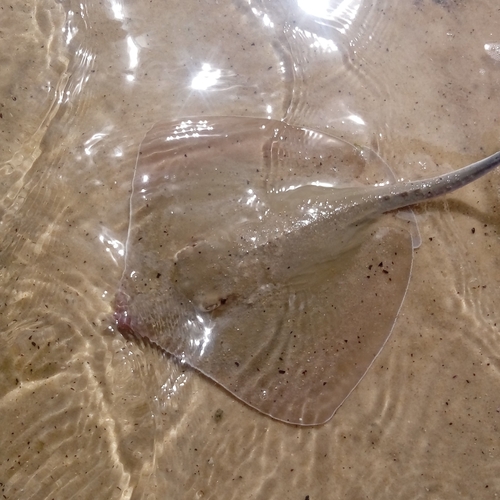
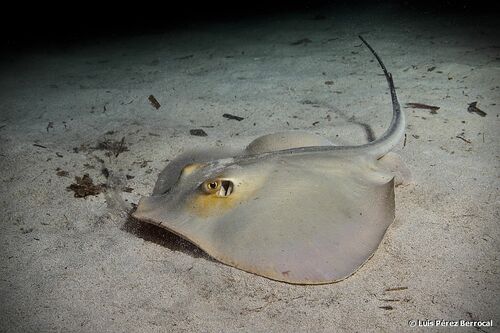
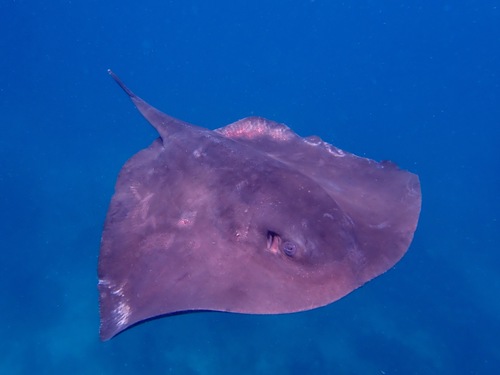
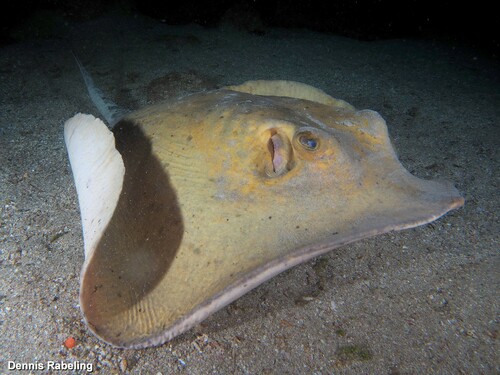
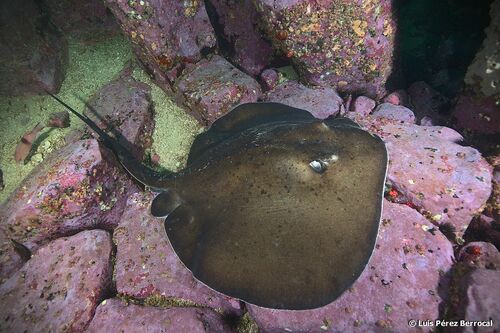
The round fantail stingray, with the scientific name Taeniura grabata (Geoffroy Saint-Hilaire, 1817), has a nearly circular pectoral fin disk that is slightly wider than it is long. Its tail is no longer than the length of the disk, and carries one or more stinging spines on its upper surface. On average, these spines are 50 mm (2.0 in) long in males and 66 mm (2.6 in) long in females. Each spine has a central groove and 29–45 lateral serrations, and replacement spines grow in front of the primary spine. A deep fin fold runs along the underside of the tail from the level of the spine almost to the tail tip. Most of its skin is smooth, with the exception of small dermal denticles along the middle of the back, from the spiracles to the tail spine, plus three thorns on its "shoulders". The upper side of the ray is dark gray, brown, or olive, with varied darker mottling, while the underside is off-white. This species typically reaches up to 1 m (3.3 ft) across the disk and 1.5 m (4.9 ft) long, though individuals have been reported reaching 2.5 m (8.2 ft) in length, and can weigh as much as 150 kg (330 lb). The round fantail stingray occurs in tropical to subtropical waters of the eastern Atlantic, ranging from Mauritania to Angola, and is also found off the Canary Islands, Madeira, and Cape Verde. It is occasionally sighted in the Mediterranean Sea, and appears to be common in the Gulf of Gabes and Levantine waters. It cannot be classified as a Lessepsian migrant, as existing reports of its presence in the Red Sea are considered erroneous. It inhabits depths between 10 m (33 ft) and 300 m (984 ft), and prefers coastal habitats with sand, mud, or rock. Little is known about the natural history of the round fantail stingray. It is a predator that feeds on bottom-dwelling crustaceans and fishes. During the day, it is often found partially buried in sediment, hiding under ledges, or resting in open spaces between reefs. Documented parasites of this species include several monogeneans: Dendromonocotyle taeniurae and Neoentobdella apiocolpos infest the skin, while Heterocotyle forcifera, H. mokhtarae, and H. striata infest the gills. The tapeworm Rhinebothrium monodi infests its spiral valve intestine. The round fantail stingray has been observed being cleaned by the cleaner shrimp Hippolysmata grabhami. Like other stingrays, it reproduces through aplacental viviparity.