About Tadorna tadornoides (Jardine & Selby, 1828)
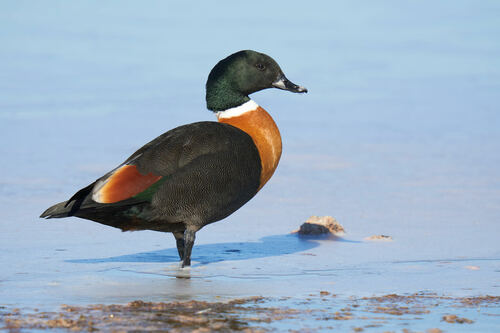
This species, the Australian shelduck, has the scientific name Tadorna tadornoides (Jardine & Selby, 1828). Adult males are mostly dark, with a dark green head, a white neck collar, and a chestnut breast. Adult females are similar in general appearance to males, but are smaller and have white markings around the eyes. Both adult males and females have chestnut and black wings with a green speculum, and display white patches on their wings when in flight. Downy young are white, with a brown crown and brown stripes running from the crown to the tail. Juvenile males are duller in color than adult Australian shelducks, and also lack the adult male's white collar. Juvenile females have extensive white plumage across most of their body, except for the crown. Males produce deep honking vocalizations similar to those of geese, while females give high-pitched, penetrating calls that sound like "zeek, zeek". Australian shelducks measure 56–72 centimetres (22–28 in) in length, have a wingspan of 94–132 cm (37–52 in), and weigh between 1.3–1.6 kg (2.9–3.5 lb). The Australian shelduck mainly breeds in southern Australia and Tasmania, where it remains fairly common. Many individuals move further north than their breeding range during the winter. Like other shelducks, this species has preferred moulting grounds; sizeable concentrations gather at sites such as Lake George, New South Wales. Its primary habitat is lakes located in fairly open country. Australian shelducks can form flocks of 1000 individuals or more. They are extremely wary of humans, and often call when humans are present, though populations in urban areas can become accustomed to people. When grazing on land, they hold an upright posture, and when on water they sit high on the surface. Young birds dive frequently, while adult birds only dive when they are flightless during moulting, or when they are injured or frightened. Australian shelducks feed through grazing, dabbling, and filtering. Their diet includes tubers and other plant material such as saltbush and samphire, alongside a variety of insects, crustaceans, and molluscs.