About Tadorna ferruginea (Pallas, 1764)
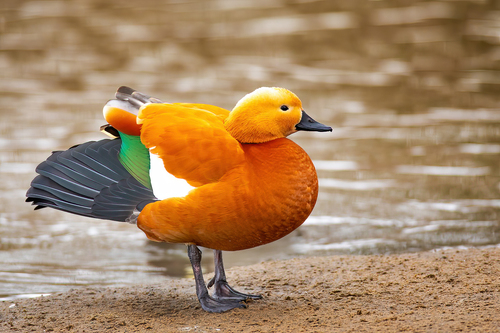
The ruddy shelduck (scientific name Tadorna ferruginea (Pallas, 1764)) grows to a length of 58 to 70 cm (23 to 28 in) and has a wingspan of 110–135 cm (43–53 in). The male has orange-brown body plumage, with a paler orange-brown head and neck that is separated from the body by a narrow black collar. The rump, flight feathers, tail-coverts, and tail feathers are black, and there are iridescent green speculum feathers on the inner wing surfaces. Both the upper and lower wing-coverts are white; this feature is especially noticeable in flight, but is barely visible when the bird is at rest. The male's bill is black, and its legs are dark grey. The female is similar to the male, but has a rather pale, whitish head and neck and lacks the black collar. For both sexes, coloring is variable and fades as feathers age. The birds moult at the end of the breeding season, and the male loses his black collar; a further partial moult between December and April restores the collar. Juveniles are similar to the female, but are a darker shade of brown. The ruddy shelduck's call is a series of loud, nasal honking notes, and it is possible to tell the difference between calls produced by males and females. Calls are given both on the ground and in the air, and sounds vary based on the circumstance of calling. There are very small resident populations of this species in Northwest Africa and Ethiopia, but the main breeding area of the bird extends from southeast Europe across the Palearctic to Lake Baikal, Mongolia, and western China. Eastern populations are mostly migratory, and winter in the Indian subcontinent. This species has colonized the island of Fuerteventura in the Canary Islands; it first bred there in 1994, and reached a population of almost fifty pairs by 2008. The ruddy shelduck is a common winter visitor in India, where it arrives by October and departs by April. Its typical breeding habitat is large wetlands and rivers with mud flats and shingle banks, and it is found in large numbers on lakes and reservoirs. It breeds in high altitude lakes and swamps in Jammu and Kashmir. Outside the breeding season, it prefers lowland streams, sluggish rivers, ponds, flooded grassland, marshes, and brackish lagoons. Although it has become quite rare in Southeastern Europe and southern Spain, the ruddy shelduck is still common across much of its Asian range. It may be this population that leads to vagrancy as far west as Iceland, Great Britain, and Ireland. However, since the European population is declining, it is likely that most occurrences in Western Europe in recent decades are escapes or feral birds. While this bird is occasionally observed in the wild in eastern North America, no evidence has been found that this represents a genuine case of vagrancy. Feral ruddy shelduck have bred successfully in several European countries. In Switzerland, the ruddy shelduck is considered an invasive species that threatens to displace native birds. Despite actions taken to reduce numbers, the population of ruddy shelduck in Switzerland increased from 211 to 1250 individuals between 2006 and 2016. A stable non-migratory feral population exists in Moscow, where the birds settle on the ponds of city parks alongside endemic mallards. It is theorized that these birds are feral descendants of escapees from Moscow Zoo, and the population most likely formed after 1948, when the policy of clipping the birds' wings was repealed. Unlike the wild population, these Moscow ducks are non-migratory, and instead winter in non-freezing parts of the city's bodies of water. The Moscow population increased from the 1990s to the 2020s by over 20 times, reaching 3300 individuals by 2025. This shelduck mostly frequents open locations on inland bodies of water such as lakes, reservoirs, and rivers. It is seldom seen in forested areas, but does occur in brackish water and saline lagoons. Though more common in the lowlands, it also inhabits higher altitudes; in central Asia it is one of the few waterbirds, alongside the bar-headed goose (Anser indicus), found on lakes at 5,000 m (16,400 ft).