About Tadarida brasiliensis (I.Geoffroy, 1824)
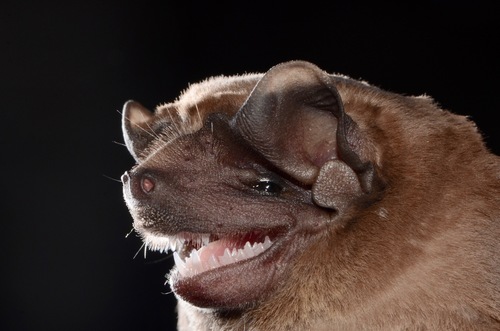
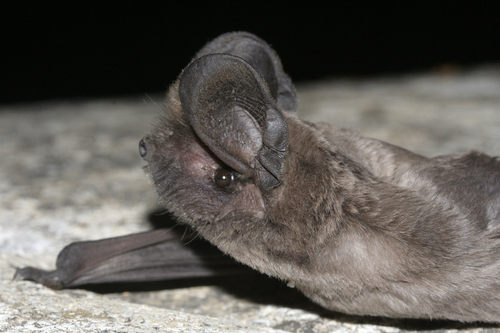
Mexican free-tailed bats, with the scientific name Tadarida brasiliensis (I.Geoffroy, 1824), have the following physical characteristics. Adults are typically 9 cm (3.5 in) long and weigh around 7–12 g (0.25–0.42 oz). Females are usually 1–2 grams heavier than males, as they store extra fat to support gestation and nursing. Their tails make up almost half of their total body length and extend past the uropatagium, which gives the species its "free-tailed" common name. Their ears are wide, rounded, and large relative to their head size. The ears nearly meet at the front of the face, are distinctly not joined at the midline, and project anterodorsally from the area just before the muzzle back to the back of the head. The bats use their large ears to locate prey through echolocation. Among North American Tadarida bats, T. brasiliensis is set apart by deep wrinkles on its upper lip and a Z-shaped upper third molar, which it uses to grind insects. Male individuals have larger canines than females. Their wings are elongated, narrow, and have pointed tips, a shape that supports fast, straight flight patterns. Their fur color varies from dark brown to gray. They have large feet with distinctive long white bristles. These bristles, located on the first and fifth digits, the toes, and the edge of the uropatagium, are photoluminescent when exposed to ultraviolet light. It is currently unknown whether this trait serves any functional purpose. The dental formula of Tadarida brasiliensis is 1.1.1.3 3.1.2.3.
This species ranges from the southern half of the continental United States, through most of Mexico and most of Central America, and into South America. Its distribution in South America is not well understood; confirmed populations live in the eastern Brazilian highlands and coast, the northeastern Andes, the coast of Peru and northern Chile, and central Argentina. The species is absent from most of the Amazon rainforest. It also lives in the Caribbean, and is native to all of the Greater Antilles and 11 of the Lesser Antilles. The largest known colony of this species is located at Bracken Cave, north of San Antonio, Texas, and holds nearly 20 million bats. Bats from this colony gather in large groups at altitudes between 180 and 1,000 m (590 and 3,280 ft), and have been recorded as high as 3,000 m (9,800 ft).
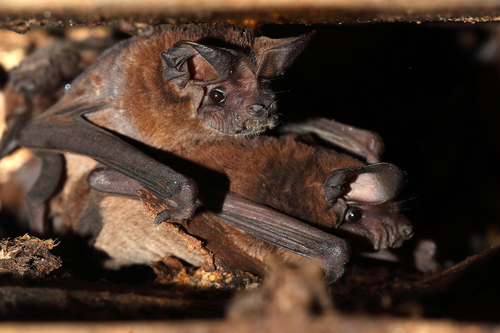
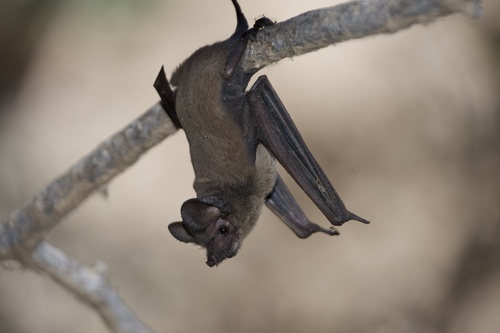
Mexican free-tailed bats roost primarily in caves, but will also roost in any type of building, as long as the building has access to openings and dark recesses in its ceilings or walls. They can roost in buildings regardless of the building's age, height, architecture, construction materials, human occupancy, or compass orientation. Caves used for roosting need to have enough wall and ceiling space to accommodate millions of bats. Before human-built structures were available, free-tailed bats in the Southeastern United States likely roosted in the hollows of trees including red mangrove, black mangrove, white mangrove, and cypress. Today, most bats in Florida prefer buildings and other man-made structures over natural roosting sites. Caves in Florida are mostly occupied by the southeastern myotis, because Florida caves usually have pools of water on the floor and create higher relative humidity than Mexican free-tailed bats require, unlike the needs of the southeastern myotis.
During the breeding season, female Mexican free-tailed bats gather in maternity roosts. The size of these roosts depends on the local environment, with caves supporting the largest roosts. Mating can occur in either an aggressive or passive form. In aggressive mating, the male controls the female's movements to keep her away from other bats in the roost, and he typically vocalizes while mating. In passive copulation, a male simply flies to a female in her roost and mounts her quietly, with no resistance from the female. This species is promiscuous, and both sexes mate with multiple partners. Females reach sexual maturity at around 9 months old, while males take longer, reaching maturity at two years old. Females enter estrus once per year, and their estrus period typically lasts five weeks during the spring. The gestation period lasts 11–12 weeks, and females give birth to only one young per pregnancy. After birth, many pups are left in shared groups called creches while their mothers roost elsewhere. Females use vocalizations and scent to identify their own pups, and mothers imprint their own scent on their young early in development. Despite this, pups will attempt to nurse from any female that passes through the cluster. Genetic analysis of female-pup nursing pairs sampled from Texas colonies shows that nursing is partially selective along genetic lines; approximately 17% of females nurse pups that are not their own, likely because it is difficult to consistently find and exclusively nurse their own pups in extremely large colonies. Mothers nurse their young daily, and by 4–7 weeks of age the pups are fully grown, fully weaned, and independent.