About Tachypleus tridentatus (Leach, 1819)
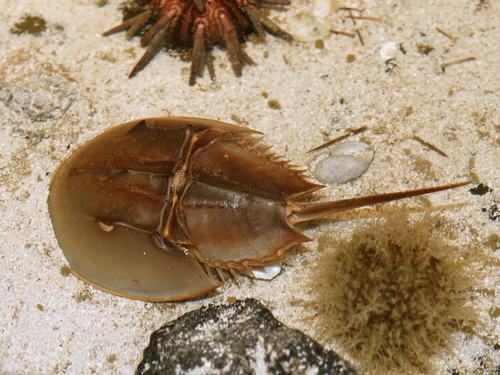
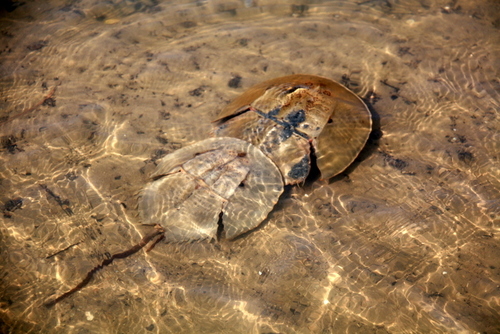
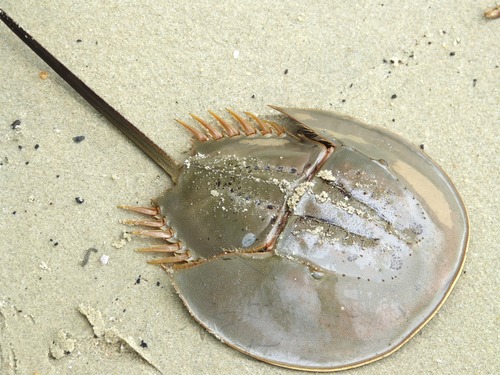
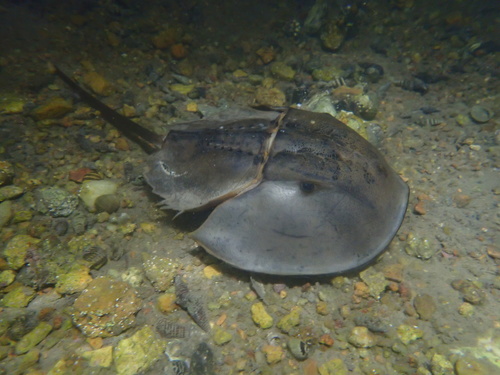
Tachypleus tridentatus, the tri-spine horseshoe crab, is not a true crab. It is most closely related to spiders and scorpions, and may even be classified as an arachnid. Its cephalothorax is protected by a single large, horseshoe-shaped plate, and neither the cephalothorax nor the abdomen shows visible segmentation. A long spike called the telson is attached to its tail. Like all other horseshoe crabs, T. tridentatus’s carapace is divided into a larger frontal section, called the prosoma, and a smaller rear section with a spiny edge, called the opisthosoma. It has six pairs of prosomal appendages (legs): one small pair positioned in front of the mouth, and five larger walking/pushing legs arranged on either side of the mouth. Book gills sit on the underside of the opisthosoma. Both the common name tri-spine horseshoe crab and the specific epithet tridentatus reference the three small spiny processes on the rear of the opisthosoma: one central spine above the tail, and one spine on each side. Other living horseshoe crab species only have a single central spine in this location. The tri-spine horseshoe crab is the largest of all living horseshoe crab species. Like other horseshoe crab species, females grow larger than males. The largest recorded females can reach up to 79.5 cm (31.3 in) in total length, including the tail. Average measurements from Sabah, Malaysia put females at about 66.5 cm (26.2 in) total length with a 34.5 cm (13.6 in) tail, and a prosoma (carapace) about 31 cm (12 in) wide. By comparison, average males from Sabah measure about 54 cm (21 in) total length with a 28.5 cm (11.2 in) tail, and a carapace about 25.5 cm (10.0 in) wide. This species shows significant geographic variation in body size that does not follow a clear north–south or east–west pattern. The largest individuals are from the Kota Kinabalu region of Malaysia, where average carapace width is around 38 cm (15 in) for females and 28 cm (11 in) for males. The smallest individuals are from the Zhoushan region of China, where average carapace width is around 24 cm (9.4 in) for females and 22 cm (8.7 in) for males. Intermediate average sizes have been reported across multiple locations: 28 to 33 cm (11–13 in) for females and 23 to 27 cm (9.1–10.6 in) for males, from Imari (Japan), Xiamen (China), the Philippines, and Manado, Tarakan, Padang, and Sibolga (Indonesia). Females typically reach sexual maturity at a carapace width of 27.5–28 cm (10.8–11.0 in), while males reach maturity at 22.5–24.5 cm (8.9–9.6 in). Adult females weigh 1.4–4 kg (3.1–8.8 lb), and adult males weigh 0.6–1.7 kg (1.3–3.7 lb). In addition to size differences, males have hooks on their two front pairs of walking legs (prosomal appendages two and three; these appendages are scissor-like in females), and six long spines on either side of the rear carapace, while females only have three long spines per side. Juveniles of both sexes have six long spines per side, matching the pattern of adult males. Development from hatching to adulthood takes 4 years, and goes through 15 instar phases (requiring 14 moults). Like other horseshoe crab species, T. tridentatus is an omnivore that feeds on molluscs, worms, other benthic invertebrates, and algae. Females lay large clutches of eggs in holes dug into sandy beaches in dedicated coastal nursery areas. After hatching, larvae stay in the nest over winter, surviving on their egg yolk for several months, and remain in the nursery area through the following spring and summer. Juveniles stay buried in sediment during high tide, and emerge to feed on the exposed surface during low tide. They have limited ability to disperse over long distances. Adults move offshore to spend winter, hibernating buried in the seabed at depths around 20 metres (66 ft), and return inshore once water warms the following year. As a poikilotherm, this horseshoe crab is strongly affected by rising seawater temperatures; it responds by burying deep in sediment, and sometimes enters diapause.