About Tachypleus gigas (O.F.Müller, 1785)
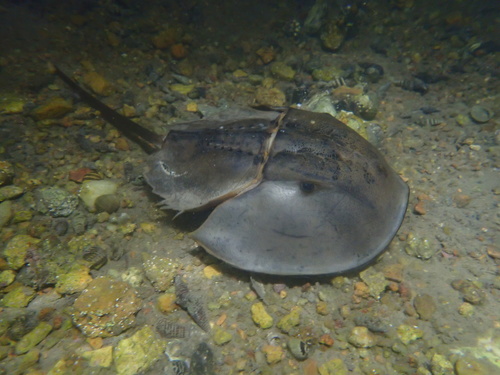
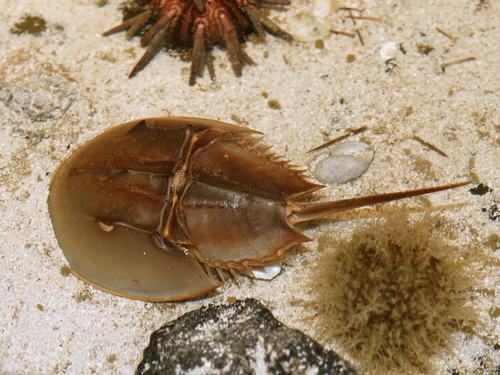
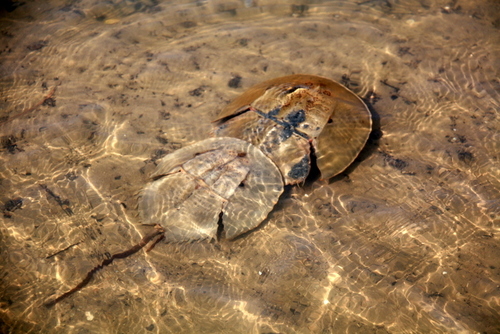
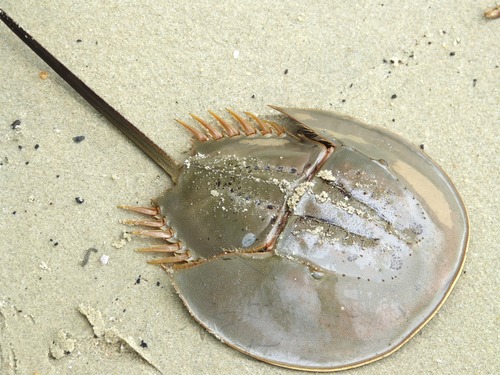
This species reaches a total length of around 50 cm (20 in) including its tail, and is covered by a sturdy carapace that can grow up to approximately 26.5 cm (10.4 in) wide. Tachypleus gigas has a sage-green chitinous exoskeleton. Like all other horseshoe crabs, the carapace of T. gigas is made up of a larger front section called the prosoma, and a smaller rear section called the opisthosoma that has spines along its edge. There are six pairs of appendages (legs) on the prosoma: one small pair positioned in front of the mouth, and five larger walking and pushing legs on either side of the mouth. Book gills sit on the underside of the opisthosoma. T. gigas has a long spiny tail called a telson, which has a crest along its dorsal side and is concave on its ventral side, resulting in an essentially triangular cross-section. Despite carrying the scientific name T. gigas, meaning giant, the species' close relative Tachypleus tridentatus grows to a larger size. Both Tachypleus gigas and Tachypleus tridentatus are considerably larger than the third Asian horseshoe crab species, Carcinoscorpius rotundicauda. The carapace that covers the prosoma also holds two pairs of eyes: a pair of simple eyes at the front, and a pair of compound eyes placed on the lateral sides. Like other horseshoe crabs, T. gigas also has additional ventral eyes near its mouthparts, and photoreceptors in its caudal spine. Tachypleus gigas is one of four living species of horseshoe crab, and one of three living horseshoe crab species native to Asia. The other two Asian species are Tachypleus tridentatus and Carcinoscorpius rotundicauda, while the fourth living species, Limulus polyphemus, occurs in the Americas. T. gigas is distributed across tropical South and Southeast Asia, with its range extending from the Bay of Bengal to the South China Sea. Confirmed records of the species exist from India, Malaysia, Singapore, Indonesia, Thailand, Vietnam and the Philippines; while no confirmed records are available, it is thought to also occur in Myanmar. Tachypleus gigas lives in seagrass meadows and on sandy and muddy shores at depths up to 40 m (130 ft). It is the only horseshoe crab species that has ever been observed swimming at the surface of the ocean. The species can live in both fully marine and brackish waters, tolerating salinities as low as 15 PSU, but its eggs will only hatch when salinity is above 20 PSU. The diet of T. gigas is made up primarily of molluscs, detritus, and polychaetes, which the species forages for on the ocean floor. House crows have been observed flipping T. gigas over to feed on its soft underside, while gulls only attack individuals that are already stranded upside-down. Because horseshoe crabs stop moulting once they reach sexual maturity, their exoskeletons are very often colonised by epibiontic organisms. The dominant diatom epibionts belong to the genera Navicula, Nitzschia, and Skeletonema. Among larger epibiontic organisms, the most common colonisers of T. gigas are the sea anemone Metridium, the bryozoan Membranipora, the barnacle Balanus amphitrite, and the bivalves Anomia and Crassostrea. Rarer epibionts recorded on T. gigas include green algae, flatworms, tunicates, isopods, amphipods, gastropods, mussels, pelecypods, annelids, and polychaetes.