About Tachymarptis melba (Linnaeus, 1758)
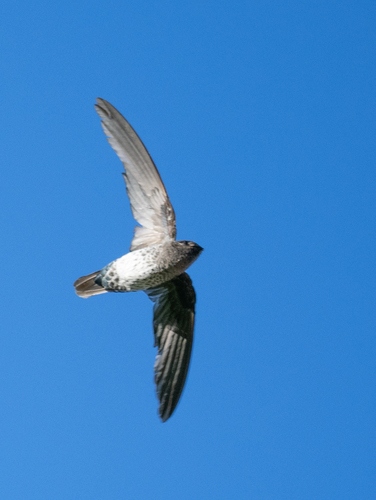
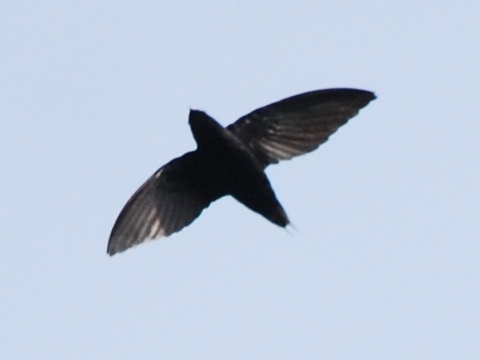
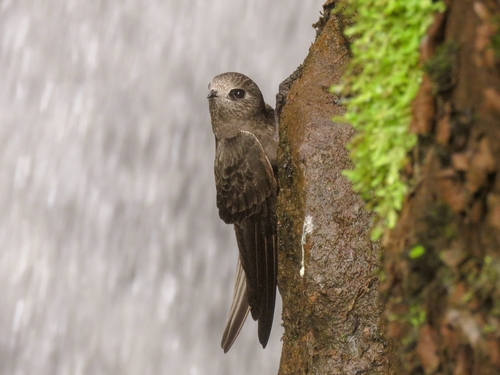
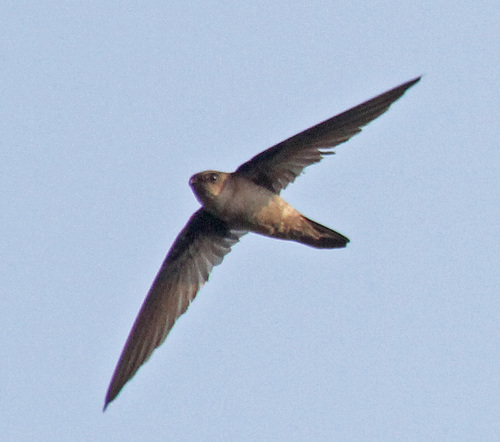
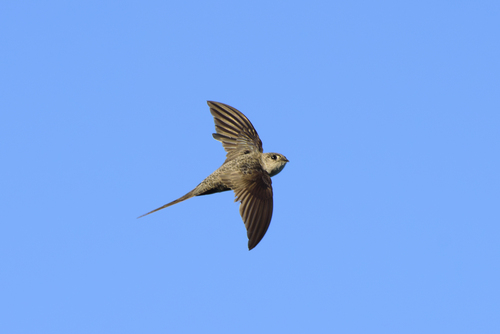
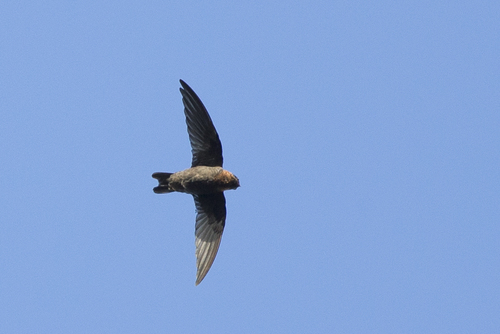
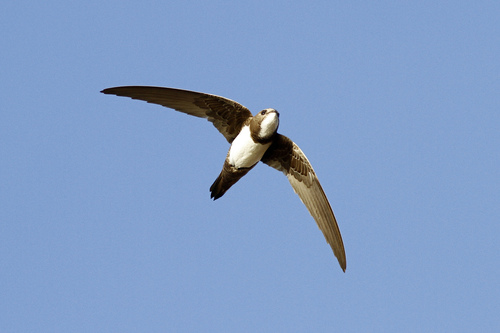
Tachymarptis melba, the alpine swift, is a large swift species in the order Apodiformes. It measures 20–22 cm in length with a 54–60 cm wingspan, has broad wings and a shallow forked tail. It is superficially similar to unrelated large barn swallows or house martins, a resemblance likely resulting from convergent evolution that reflects their similar lifestyles. Its upperparts are olive-brown, with long, sharp wings that have blacker wingtips. Its underparts have a white throat that is often not easily visible, and a highly visible, distinctive oval white belly patch surrounded by an olive-brown breastband, flanks, and undertail-coverts. Multiple recognized subspecies differ in size and plumage: the subspecies tuneti and marjoriae are paler, with grey-brown plumage; archeri is typically paler than tuneti and has shorter wings; maximus is the largest subspecies, with very dark, blackish plumage; africanus and nubifugus are smaller than the nominate subspecies, with blacker plumage, a smaller throat patch, and blacker shaft-streaks on white areas; willsi and bakeri are both smaller, with darker plumage and have broader and narrower breast bands respectively; dorabtatai has a broader breast band and shorter wings than nubifugus, and is distinguished from bakeri by its paler plumage and broader breast band. By average measurements, alpine swifts are around twice the size of most other swifts in their range: they measure 20 to 23 cm in length, have a wingspan of around 57 cm, and weigh around 100 g. For comparison, the common swift has a wingspan of around 42 cm. Alpine swifts have very long swept-back wings that resemble a crescent or a boomerang, and may be held completely straight out. Their flight is slower and more powerful than that of smaller related swifts, and their call is a drawn-out twittering. They are easily distinguished from common swifts by their larger size, white belly, and white throat; they are largely dark brown, with a dark neck band that separates the white throat from the white belly. Juveniles resemble adults, but have pale-edged feathers. Alpine swifts breed in mountain regions from southern Europe to the Himalaya. Like common swifts, they are strongly migratory, and winter much further south in southern Africa. They wander widely during migration, and are regularly seen across much of southern Europe, the Middle East, and Asia. Fossil evidence shows the species was much more widespread during the last ice age: large breeding colonies existed in what is now Bulgaria's Late Pleistocene Cave No 16 around 18,000–40,000 years ago, and in Komarowa Cave near Częstochowa, Poland around 20,000–40,000 years ago. This species builds nests in colonies in cliff holes or caves, and lays two or three eggs per clutch. Swifts return to the same breeding sites each year, rebuild nests as needed, and pair for life. If bad weather prevents parent birds from catching insects nearby, young swifts in the nest can drop their body temperature and enter torpor. They have adapted well to urban environments, and frequently nest in old buildings in Mediterranean towns, where large low-flying flocks are a common summer sight. Tachymarptis melba is a polytypic species with 10 recognized subspecies. It is present year-round in eastern and southern Africa, Madagascar, western peninsular India, and Sri Lanka. It has a larger non-breeding range covering western, eastern, and southern Africa, and parts of the western edge of the Arabian peninsula. It breeds across southern Europe from the west through Turkey, north through the Caucasus, along the east coast of the Black Sea to the Crimean peninsula, through Central Asia to Turkestan, and south through Iran and Afghanistan to Balochistan in Western Pakistan, and further east along the Himalayas. There are also scattered populations in northwestern Africa, including an isolated population in Northern Libya. Vagrant individuals have been recorded in parts of the Americas, including Bermuda, Brazil, Barbados, Puerto Rico, French Guiana, Saint Lucia, and Guadeloupe. The 10 recognized subspecies are: (1) T. m. melba, described by Linnaeus (1758) with type locality Gibraltar, weighing 76–120g, distributed across southern Europe east from the Iberian Peninsula and northern Morocco, east through Asia Minor to northwest Iran, and wintering in west, central, and east Africa; (2) T. m. tuneti, described by von Tschusi in 1904 with type locality Tunisia, weighing 95–110g, distributed from central and eastern Morocco eastwards to Libya, through the Middle East and Iran (excluding the northwest where T. m. melba occurs) to southeast Kazakhstan and western Pakistan, and wintering in west and east Africa; (3) T. m. archeri, described by Hartert (1928) with type locality Hargeisa, Somaliland, distributed from the Dead Sea depression on the borders of Israel and Jordan, south to southwest Arabia and Somalia; (4) T. m. africanus, described by Temminck (1815) with type locality South Africa, weighing 67–87g, distributed across east and southern Africa and southwest Angola, with some populations wintering in east Africa; (5) T. m. maximus, described by Ogilvie-Grant (1907) with type locality on the eastern slopes of the Rwenzori mountains at 3,000–3,700 m, averaging 128g, distributed across Uganda and DR Congo; (6) T. m. marjoriae, described by R D Bradfield (1935) from Quickborn, Damaraland, distributed in Namibia and adjacent northwestern Northern Cape, western South Africa; (7) T. m. willsi, described by Ernst Hartert (1896) from Madagascar, and is endemic to the island; (8) T. m. nubifugus, described by Koelz (1854), distributed across the Himalayas and wintering in central India; (9) T. m. dorabtatai, described by Abdulali (1965), distributed in western peninsular India; (10) T. m. bakeri, described by Hartert (1928) from Sri Lanka, distributed only on that island. In the western Palearctic's temperate and Mediterranean zones, alpine swifts typically occupy mountains, and occasionally occur in lowlands. In the rest of sub-Saharan Africa and south Asia, they occur in a wider range of habitats, from sub-desert steppe to mountains. They typically breed below 1,500 m, and may occasionally breed up to 2,300 m. In the tropical Kenyan part of their range, they have been recorded breeding above 4000 m; in the Himalayas, they have been observed foraging at 3,700 m; probable nesting sites at 2,100 m have been recorded on Madagascar. Alpine swifts have a powerful, rapid flight with deep, slow wing beats. They engage in twilight ascent: increased flight activity, gaining altitude, and longer-distance horizontal flight at dawn and dusk, which may be part of social interactions between individuals. Alpine swifts spend most of their lives in the air, feeding on insects caught in their beaks. They drink while flying, and roost on vertical cliffs or walls. A 2013 study confirmed alpine swifts can spend over six months flying without landing, and all vital physiological processes including sleep can occur while airborne. In 2011, Felix Liechti and colleagues at the Swiss Ornithological Institute attached electronic movement-logging tags to six alpine swifts, and discovered the birds could stay aloft continuously for more than 200 days. The alpine swift's diet consists mainly of arthropods, primarily insects, and also includes spiders. Insects from 10 orders and 79 families have been recorded in the diets of individuals from Africa and Europe, with Homoptera, Diptera, and Hymenoptera being the most commonly consumed groups.