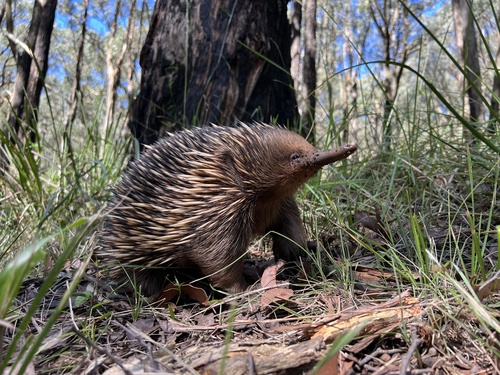
About Tachyglossus aculeatus (Shaw, 1792)
The short - beaked echidna (Tachyglossus aculeatus) typically measures 30 to 45 cm in length, with a 75 - mm snout, and weighs 2 to 7 kg. The Tasmanian subspecies, T. a. setosus, is smaller than those on the Australian mainland. Its neck is not externally visible, making the head and body seem merged. The earholes are on the sides of the head without external pinnae. The small eyes, about 9 mm in diameter, are at the base of the wedge - shaped snout. The nostrils and mouth are at the end of the snout, and the mouth can't open wider than 5 mm.
The body, except for the underside, face, and legs, is covered with cream - coloured spines up to 50 mm long, which are modified hairs made mostly of keratin. Fur between the spines provides insulation, ranging in colour from honey to dark reddish - brown or black. The underside and short tail are also furry. The echidna may be infested with the 4 - mm flea, Bradiopsylla echidnae.
The short - beaked echidna's limbs are adapted for rapid digging. They are short with strong claws, enabling it to tear apart logs and move heavy objects. The limb power comes from strong musculature, especially around the shoulder and torso. The mechanical advantage of its arm is greater than that of humans. The hind - foot claws are elongated and curved backward for grooming.
The echidna has a low body temperature, between 30–32 °C, and can drop to 5 °C. It doesn't pant or sweat and seeks shelter in hot conditions. It loses water while exhaling, and the snout helps restrict this loss. It doesn't have highly concentrated urine, and about half of its daily water loss of 120 g occurs through urine, with the rest through the skin and respiratory system. It replenishes water by eating termites and can also drink water or lick dew.
In autumn and winter, the echidna enters torpor or hibernation. It becomes sluggish in extreme temperatures. Like all monotremes, it has a cloaca. The male has internal testes, no scrotum, and a four - knobbed penis nearly a quarter of his body length when erect. The gestating female develops a pouch.
The echidna's musculature has unique features. The panniculus carnosus covers the body, allowing it to change shape and roll into a ball for defense. It has one of the shortest spinal cords among mammals, which may aid in ball - rolling. The face, jaw, and tongue muscles are specialized for feeding. The sticky tongue can protrude up to 180 mm, moving in and out 100 times a minute to catch prey. The tongue is stiffened by blood flow and can bend to catch insects. It can eat quickly, and its stomach is different from other mammals, with low acidity and a cornified epithelium.
Physiologically, the echidna can tolerate high carbon dioxide levels, dig deeply, survive low - oxygen situations like bushfires, and dive underwater. Its heart rate drops during such events. After a bushfire, it can use torpor to reduce activity.
The echidna's optical system has both mammalian and reptilian characteristics. It has a flat lens for clear long - distance vision but no ciliary muscle for focusing. It can distinguish black and white and stripes. Its ears are sensitive to low - frequency sounds, and the pinnae are covered by hair. The snout has mechano - and thermoreceptors and electroreceptors, and push rods on the snout help detect prey. It has a well - developed olfactory system and a sensitive optic nerve.
The echidna's brain has a large prefrontal cortex relative to body size, leading to debates about its reasoning ability. It shows rapid eye movement during sleep at 25 °C.
Echidnas live alone and have no fixed shelter. Their range area varies from 9–192 ha, with a mean of 40–60 ha. They are typically diurnal but become crepuscular or nocturnal in warm weather to avoid heat. They can swim to cool down. They hibernate in winter, with males starting first and reproductive females starting later. During hibernation, their body temperature, heart rate, and metabolism drop significantly.
They locate food by smell and possibly hearing. They eat ants, termites, beetle larvae, and earthworms. They prefer termites and avoid those with chemical defences. They are powerful diggers and use their spines for camouflage. They may be keystone species in the Australian ecosystem due to bioturbation.
They are found in various habitats in Australia, including forests, agricultural scrub, grasslands, and suburbs. Their distribution in New Guinea is less known.
The short - beaked echidna mates between May and September. Males' testes enlarge before spermatogenesis. Both sexes secrete a musky odour during the mating season. Males form trains to pursue females, and courtship can last up to four weeks. Before mating, the male sniffs the female, and the female can reject the male. Mating takes half to three hours, and each mating results in a single egg.
Gestation lasts 21 to 28 days, after which the female lays a single rubbery egg into her pouch. The egg hatches in ten days. Hatchlings, called puggles, are about 1.5 cm long and attach to the mother's milk areolae. They grow rapidly, and the mother may leave them in the burrow for days. Juveniles are ejected from the pouch at two to three months and are weaned at about six months.
The mother's milk composition changes over time. The age of sexual maturity is uncertain, perhaps four to five years. In the wild, they have an average lifespan of 10 years, but can live up to 40 years. They have a multiple - sex - chromosome system, and homosexual behaviors have been observed in captivity.

