About Tachycineta thalassina (Swainson, 1827)
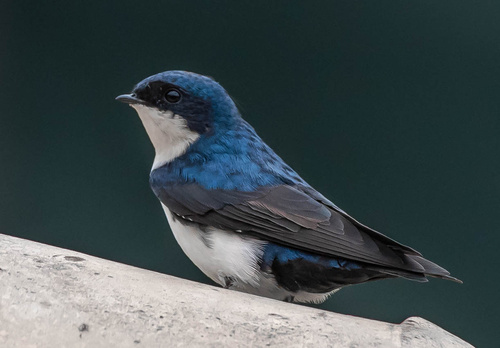
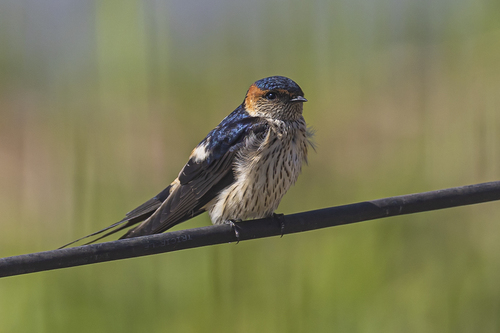
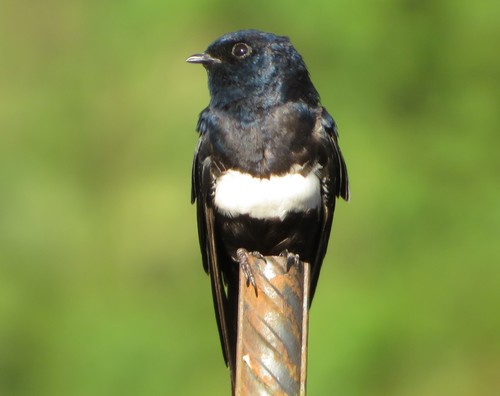
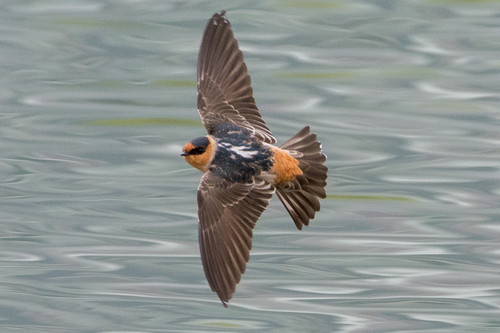
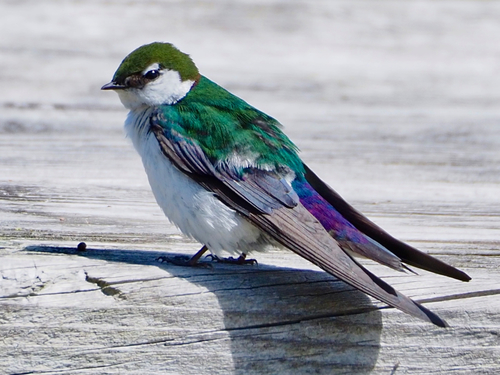
Violet-green swallows (Tachycineta thalassina) share the characteristic body form that sets swallows apart from other passerine birds. Like other swallows, they evolved long pointed wings and a slim, streamlined body to catch insects while in flight. This species has an average body length of 12–13 cm (4.7–5.1 in), making it slightly shorter and more compact in flight than other members of the genus Tachycineta. It most closely resembles the tree swallow Tachycineta bicolor, but can be told apart by more extensive white on the rump sides, and its green-and-violet glossy plumage. The habitat of violet-green swallows varies by geographic location and elevation. Across their range, they occur in deciduous, coniferous, and mixed forests, canyons, and areas near large cliffs. Breeding and non-breeding habitats are mostly similar, except breeding habitat is usually found at lower elevations. Violet-green swallows have also been recorded nesting around buildings in populated areas. Violet-green swallows are a primarily western North American species, with only rare individual sightings in eastern North America. While their distribution can be split according to recognized subspecies, the species' full range extends from central Alaska south to Mexico. Longitudinally, the range reaches along the west coast of Alaska, British Columbia, and the United States, and extends east into southwestern Alberta, Montana, the Dakotas, and Texas. Almost the entire distribution makes up the species' breeding range, while the winter range is limited only to Mexico. Violet-green swallows typically arrive at their breeding grounds several weeks before breeding begins. Depending on location, mating occurs in mid-May, and eggs are laid by early June. Eggs incubate for a couple of weeks before hatching. The average clutch holds 5 eggs, and females lay roughly one egg per day. In the weeks after hatching, parent birds feed their young as the juveniles grow their feathers. Young swallows are ready to leave the nest approximately three weeks after hatching. Most pairs breed once per breeding season, though a second brood has occasionally been observed.