About Tachycineta leucorrhoa (Vieillot, 1817)
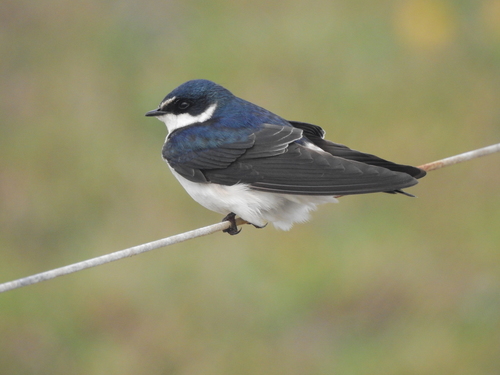
The white-rumped swallow, Tachycineta leucorrhoa (Vieillot, 1817), measures 13 centimetres (5.1 in) in length and weighs 17–21 grams (0.60–0.74 oz), with an average wingspan of 115.7 millimetres (4.56 in). It has a white supraloral streak, a white stripe above the eye, and black lores and ear coverts that carry a blue-green gloss. Its wings are black, with white tips on the inner secondaries, tertials, and greater wing-coverts; these white tips erode as the bird ages. The tail is black and shaped into a shallow fork. As the common name implies, this swallow has a white rump, which is not entirely white and marked with fine shaft streaks. All other upperparts, including the crown, nape, and forehead, are glossy blue, which becomes more greenish-blue when the bird is not breeding. The underparts and underwing-coverts are white; the bill, legs, and feet are black, and the irides are brown. The two sexes have identical plumage. Juveniles can be distinguished by their dusky breast, and their overall plumage is duller and more brownish than adults. This species is similar in appearance to the Chilean swallow, but has clear differences: the Chilean swallow lacks this species' white supraloral streak, keeps its glossy blue upperparts outside of breeding season, and is smaller than the white-rumped swallow. The song of the white-rumped swallow is generally described as a soft gurgling or a broken warble, and it usually sings while flying at dawn. Its common call is described as a quick, toneless zzt, while its alarm note is short and harsh. This swallow is native to Argentina, Bolivia, Brazil, Paraguay, Peru, and Uruguay. It inhabits open and semi-open country near water, woodland edges, and human settlements. It also occurs in dry savannas, degraded former forest, both subtropical and tropical seasonally flooded grassland, and the pampas of Argentina and Uruguay. During the austral winter, southern populations of the species typically move to the northern parts of its range. It can be found at altitudes ranging from sea level to 1,100 metres (3,600 ft).