About Tachycineta albiventer (Boddaert, 1783)
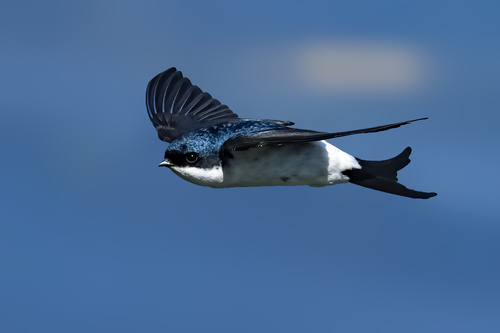
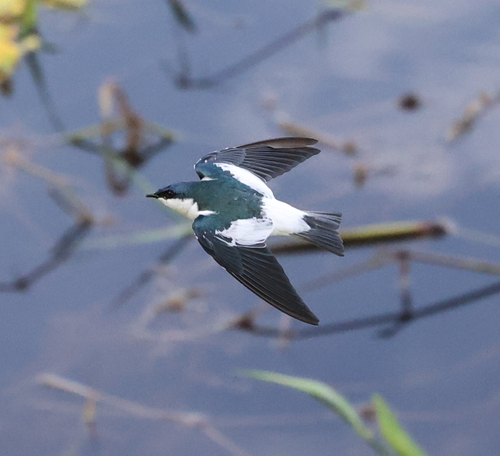
The adult white-winged swallow (Tachycineta albiventer) measures 14 cm (5.5 in) in length and weighs 14–17 g (0.49–0.60 oz). It has iridescent blue-green upperparts, white underparts and rump, and white edgings along its secondary flight feathers. The rest of its wings and its tail are black. It has dark brown eyes, plus a black bill and black legs. Males and females have similar appearances, though females have slightly less white on the wings. Compared to adults, juvenile white-winged swallows have grayer underparts, are duller overall, and also have less white on their wings. This species can be told apart from the similar mangrove swallow by its lack of a white line above its lores, and its larger amount of white on the wings. Its common calls are a harsh chirrup, or a repeated, rising, buzz-like zweeed. Its alarm call is short and harsh. The white-winged swallow is native to Argentina, Bolivia, Brazil, Colombia, Ecuador, French Guiana, Guyana, Paraguay, Peru, Suriname, Trinidad and Tobago, and Venezuela. Occasional vagrants have been recorded reaching Panama. The species is usually not found on the Pacific coast, especially in the southern portion of South America. It typically occurs in or near lowland areas alongside bodies of water such as rivers or lakes, at elevations of approximately 500 m (1,600 ft). The white-winged swallow is resident across most of its range, but it is migratory in the most southerly part of its range. In Brazil and Argentina, the species is only present from roughly mid-September to mid-April. The wintering location of this population is not well understood, but it is most likely Guianas, Venezuela, and Colombia. The white-winged swallow feeds primarily while flying at low altitude, catching flying insects. It usually forages over water, but may also feed over land. Between foraging attempts, it typically perches on branches near bodies of water. Its flight paths are direct, and it flies using flapping flight.