About Tachycineta albilinea (Lawrence, 1863)
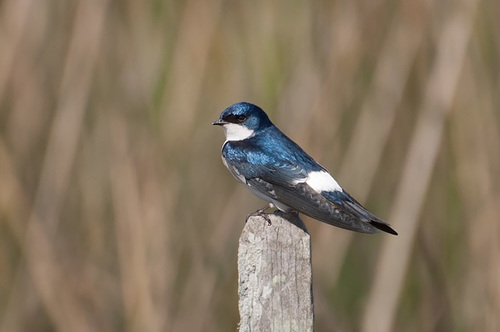
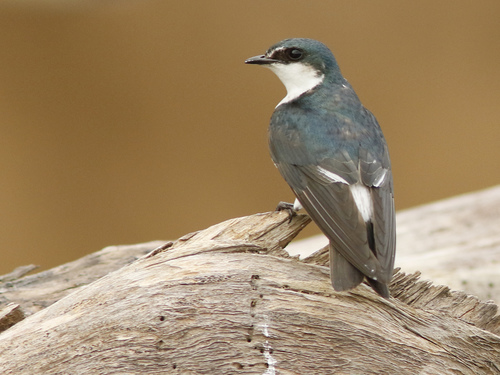
The mangrove swallow, scientifically Tachycineta albilinea (Lawrence, 1863), is a relatively small swallow species. Adults measure 11–12 centimetres (4.3–4.7 in) in length and weigh approximately 14 grams (0.5 oz). Adult individuals have iridescent blue-green upperparts, along with white underparts, rump, undertail-coverts, and wing-coverts. Their tail and flight feathers are blackish. Fresh plumage appears greener, while worn plumage appears bluer. The white underparts sometimes show faint dark shaft streaks. The small black bill measures around 11 millimetres (0.43 in) long. The iris is dark brown, and the tarsus and toes range in colour from black to fuscous-brown. The lores are black, with a thin white line just above them. This distinct marking is shared with only two other Tachycineta species: the violet-green swallow and the white-rumped swallow. The adult tail is only slightly forked. The sexes are similar in appearance, but differ slightly in size: females have a slightly longer tail and slightly shorter wings than males. Juvenile mangrove swallows are dull grey-brown on the upperparts, and grey-brown washed with white on the underparts. Occasionally, juvenile upperparts carry a subtle greenish gloss. The species' call is a rolled "jeerrrt" or a "chriet", its song is commonly described as a soft trilling, and it uses a short sharp note as an alarm. This swallow is native to Mexico and all of Central America: Belize, Guatemala, Honduras, El Salvador, Nicaragua, Costa Rica and Panama. It usually occurs near low-lying bodies of water and mangrove forests, which is how it got its common name. It has also been recorded in intertidal zones. In Mexico, it is not typically found above 600 metres (2,000 ft). In Costa Rica, it has been recorded at elevations as high as 1,000 metres (3,300 ft), but normally occurs between 500 metres (1,600 ft) and sea level, and is rarely found in highlands. The mangrove swallow is a vagrant to the United States, where it was first recorded in 2002 in Florida. While it is a full-time resident across most of its range, some limited post-breeding movement is thought to occur. The mangrove swallow is a solitary bird. Nests are never located closer than 50 metres (160 ft) to each other, and are usually separated by around 300 metres (1,000 ft). Nests are built in natural or artificial cavities near water, most often in tree stumps or dead trees. Nesting in nest boxes is also not uncommon. The nest is a few centimetres deep, constructed from grass, fine stems, moss, plus a small number of leaves and sticks, and padded with feathers. Nests are normally found below 2 metres (7 ft) in elevation. Even though nests are built relatively low, they are almost always positioned above the typical flood water level. Common nesting sites include tree holes, and crevices in rock or bridges.