About Tachornis phoenicobia Gosse, 1847
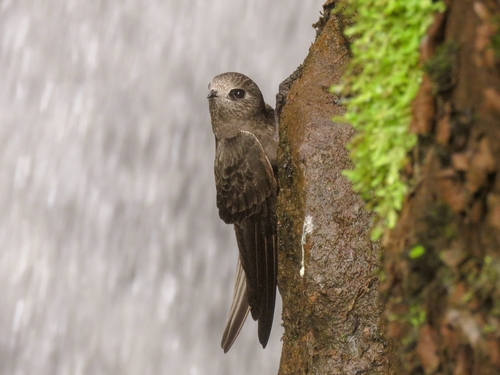
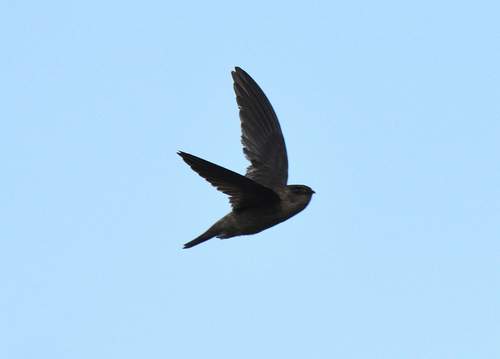
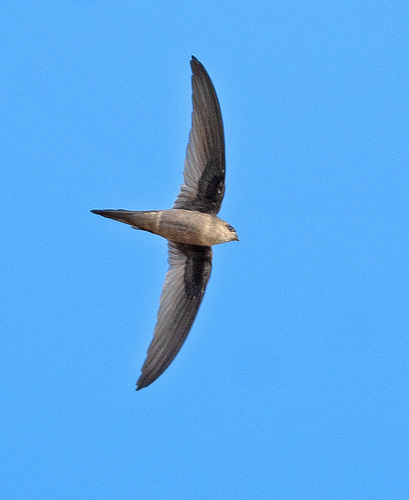
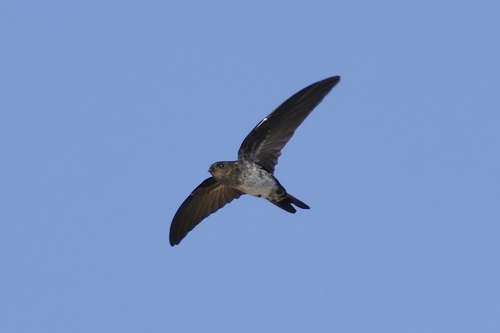
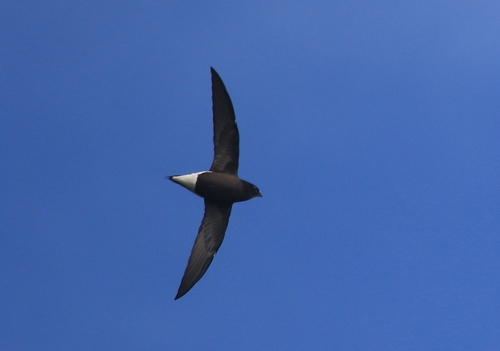
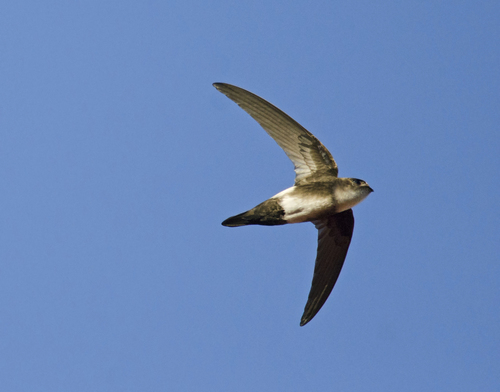
The Antillean palm swift (Tachornis phoenicobia Gosse, 1847) is 9 to 11 cm (3.5 to 4.3 in) long and weighs approximately 9 to 11 g (0.32 to 0.39 oz). It has long, narrow wings and a medium-length forked tail, and males and females look identical. Nominate subspecies adults have dark sooty brown crowns and napes. Their back, a narrow central stripe on the rump, uppertail coverts, and tail range from sooty black to black, while the sides of their rump are white. Their wings are sooty blackish with pale edges along the flight feathers. Most of their face is grayish brown. Most of their underparts are dull white; their flanks, a narrow band across the breast, and undertail coverts are dark sooty brown. Immature birds resemble adults, but their underparts are an even duller white, and their flanks and undertail coverts are a paler sooty brown. The subspecies T. p. iradii is somewhat larger than the nominate subspecies, and has a more deeply forked tail. Its back is more sooty rather than black, its face has more extensive grayish brown coloring, and its flanks are a paler sooty brown. The nominate subspecies is distributed across Jamaica, Hispaniola, and several small islands off Hispaniola's coast. T. p. iradii is found on mainland Cuba and Isla de la Juventud. The species has been recorded as a vagrant in Florida, and there are confirmed sightings from Puerto Rico, the Cayman Islands, Inagua in The Bahamas, and the Turks and Caicos Islands. The Antillean palm swift occurs over dry grassy areas with patches of palms, scrublands, forest, and suburban and urban areas. Its maximum elevation range reaches 1,700 m (5,600 ft) on Hispaniola and 1,200 m (3,900 ft) on Jamaica.