About Tachina fera (Linnaeus, 1761)
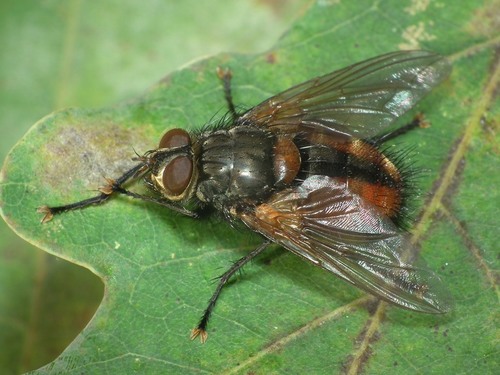
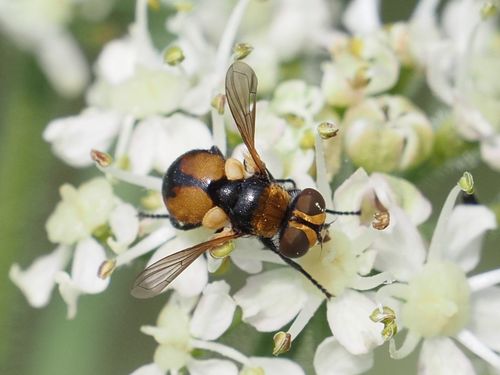
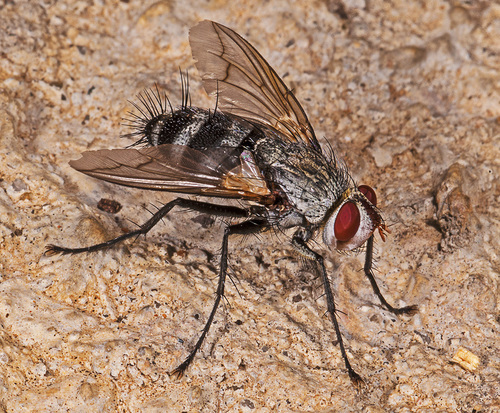
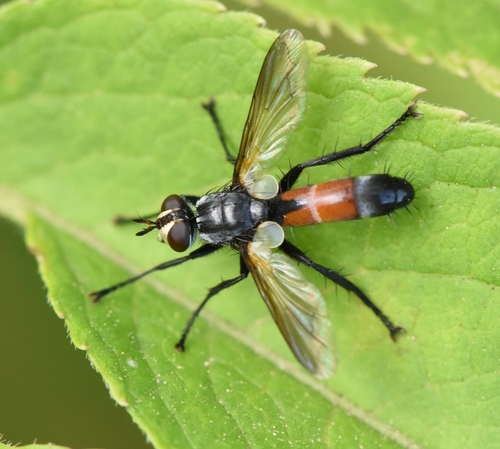
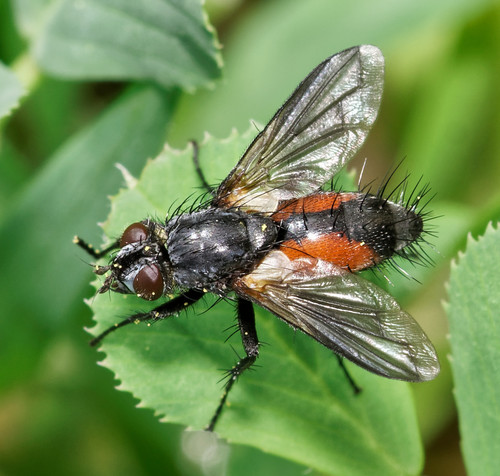
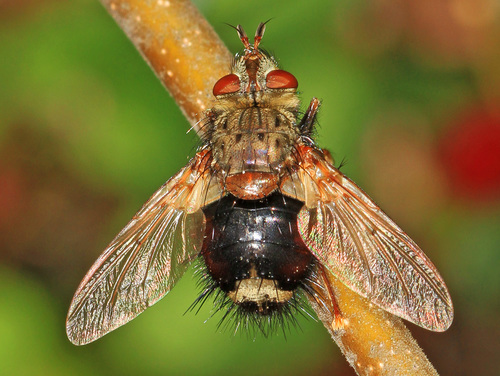
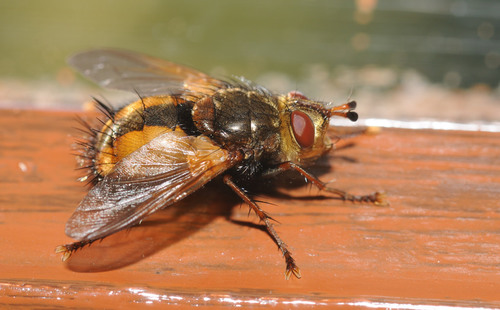
Tachina fera (Linnaeus, 1761) reaches a body length of 9–14 millimetres (0.35–0.55 in) and has a wingspan of 16–27 mm. The upperside of this tachinid fly’s thorax is grayish from dense pollinosity, marked with regular black stripes. Its abdomen is yellow-orange, with a wide black dorsal stripe that ends in a point. The thorax and abdomen are covered in bristles, particularly toward the abdomen tip, which has long, protruding, thorn-shaped black bristles. Near the base of the thorax there is a distinct, shiny orange-red structure called the postscutellum, which has a thin black edge. The head is yellowish, and bears long antennae: the second antenna segment is yellow, while the much shorter third segment is black. The back of the head has yellowish hairs, and the large compound eyes are red. The relative size of the eyes compared to the head differs between sexes. The palps of the mouthparts are long, thin, and thread-like. The wings have a slight yellow tint, brownish-yellow wing veins, and a yellow-brown base. The calyptrae are whitish yellow. The legs are mostly yellowish, but male legs are usually dark with yellow tips. This species is very similar to Tachina magnicornis, which is slightly smaller, has a medial dorsal band that forms lozenges, and does not end in a point. Tachina fera is distributed across the entire Palearctic realm. It occurs throughout Europe as far north as Scandinavia and European Russia, and is also found in Israel, North Asia extending east to China, Mongolia, Korea, and Japan, as well as in North Africa. These flies live in vegetation in humid areas, including meadows, woodland, forests, forest edges, clearings, heath, moorland, and natural gardens.