About Tacca leontopetaloides (L.) Kuntze
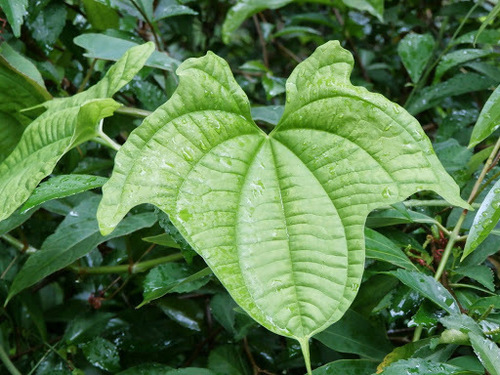
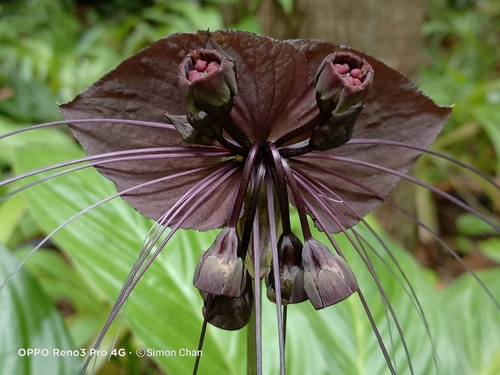
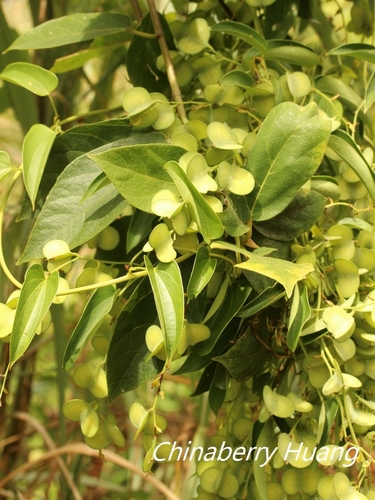
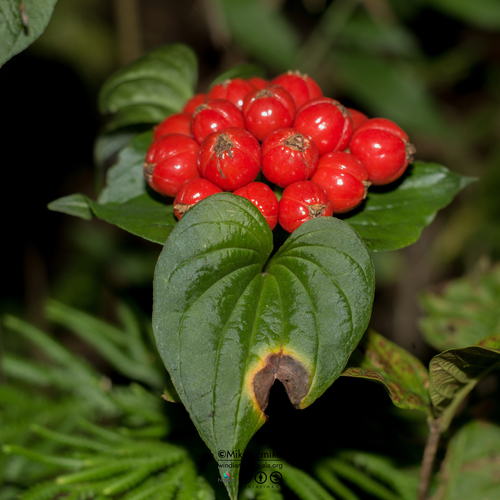
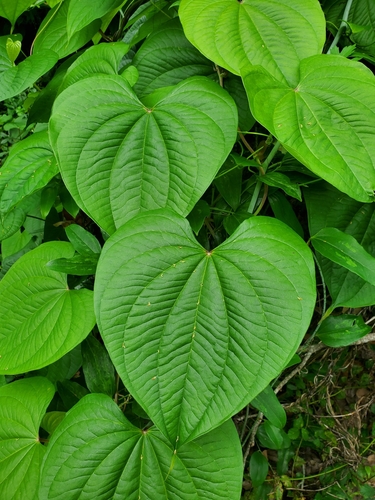
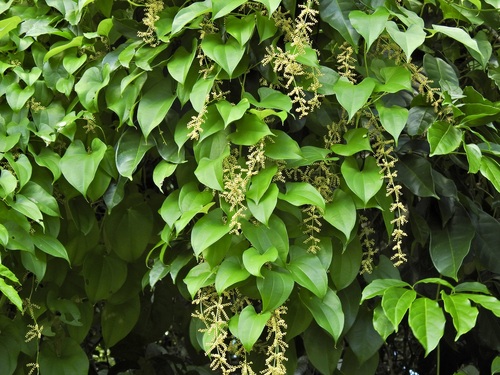
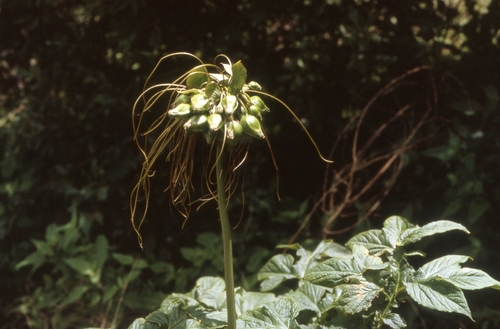
Tacca leontopetaloides, commonly known as Polynesian arrowroot, has round, hard, potato-like tubers with brown skin and a white interior. The plant goes dormant each December, when its leaves and stalks dry out and die back to the ground; new leaves re-grow starting in March. Its leaves are palmately incised and/or divided into 3 to 13 lobes, with each lobe further pinnately divided into numerous smaller sections. Several 17 to 150 cm (6.7 to 59.1 in) long petioles grow from the plant's center, resembling giant celery, and support large leaves that measure 30 to 70 cm (12 to 28 in) long and up to 120 cm (47 in) wide. The upper surface of leaves has depressed veins, while the shiny lower surface has prominent bold yellow veins. Polynesian arrowroot is an ancient Austronesian root crop closely related to yams. It is originally native to Island Southeast Asia. It was spread across the entire range of the prehistoric Austronesian expansion around 5,000 BP, reaching areas including Micronesia, Polynesia, and Madagascar. It has been identified as one of the cultivated crops at Lapita sites in Palau that date back to 3,000 to 2,000 BP. It was also introduced to Sri Lanka, southern India, and possibly Australia through trade and contact between cultures. For Austronesian peoples, Polynesian arrowroot was a minor staple. Its roots are bitter if not prepared correctly, so it was only grown as a secondary crop behind primary staples like Dioscorea alata and Colocasia esculenta. Its importance grew for settlers in the Pacific Islands, where cultivated food plants were less common, and it was introduced to nearly all inhabited Pacific islands. It was valued for its ability to grow on low islands and atolls, and was often a staple crop on islands with these environments. On larger islands, it was typically left to grow wild and only used as famine food. Centuries of artificial selection in Polynesia led to the development of several cultivars. Starch extracted from the tuber using traditional methods can be stored for a very long time, making it suitable for storage and trade. This starch can be cooked in leaves to make starchy puddings, a use similar to that of starch extracted from sago palms (Metroxylon sagu). Today, it is rarely cultivated due to the introduction of modern crops. The tubers of Polynesian arrowroot contain starch, which made it an important food source for many Pacific Island cultures, especially for people living on low islands and atolls. Polynesian arrowroot was processed into flour to make a range of puddings. To prepare it, tubers are first grated, then soaked in fresh water. The settled starch is rinsed repeatedly to remove the bitter taste of taccalin, a poisonous substance, and then dried. The resulting flour is mixed with mashed taro, breadfruit, or pandan fruit extract, then combined with coconut cream to make puddings. In Hawaii, the popular local dessert haupia was originally made with this pia flour, coconut cream, and cane sugar (kō). Today, cornstarch has largely replaced Polynesian arrowroot starch for this use. Beyond food, the starch was also used to stiffen fabrics, and on some Pacific islands, bast fibers from the plant's stem were woven into mats. In traditional Hawaiian medicine, raw tubers were eaten to treat stomach ailments. When mixed with water and red clay, the plant was consumed to treat diarrhea and dysentery. This same mixture was also used to stop internal hemorrhaging in the stomach and colon, and applied externally to wounds to stop bleeding.