About Tacca chantrieri André
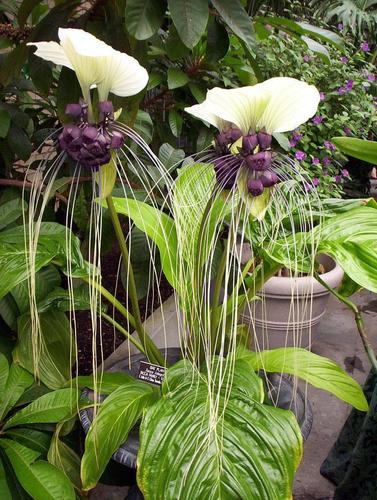
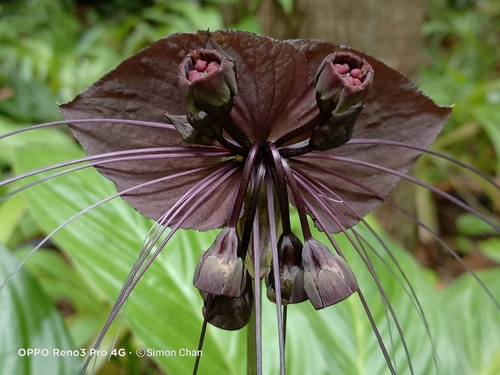
The genus Tacca contains ten species, and Tacca chantrieri André is commonly known as the bat flower, devil flower, or cat whiskers. It is an unusual plant notable for its black flowers. It has large, wing-shaped bracts, and its flowers can reach up to 12 inches across. Plants grow 50 to 100 cm in total height. Its bracteoles are long and whisker-like, hanging down to lengths of 8 to 10 inches. Some researchers hypothesize that these bracteoles have photosynthetic properties. Tacca chantrieri is native to Southeast Asia, where it occurs in Assam, Bangladesh, Cambodia, Southern China, Hainan, Laos, Malaysia, Myanmar, Thailand, Tibet, and Vietnam. It has the widest geographical distribution of any species in its genus, but its range has shrunk due to overexploitation, habitat destruction, and forest fragmentation. Flower colors of T. chantrieri range from dark brown and purple to sometimes green. While these color patterns typically act as carrion mimicry to attract animals that feed on decaying matter, this dynamic does not hold true for T. chantrieri. Flies may enter the flower opening and crawl inside, lured by the expectation of decaying matter at the flower's center. Light guides flies through the flower's internal tunnel, but since the flower offers no rewards to these visitors, the flies soon attempt to leave. The flower's structure makes exit nearly impossible, specifically its helmet-like stamens that trap the insects. It is generally expected that plants that invest more energy into large, elaborate floral structures like T. chantrieri will be more attractive to pollinators and gain the benefit of increased genetic variability from cross-pollination. However, pollination experiments with T. chantrieri have found that most of its seeds come from autonomous self-pollination, despite the species' high energy investment in its elaborate floral displays. This may stem from infrequent insect visitation. Evidence of self-pollination can also be seen in pollen bundles found on most stigmas, which indicates self-pollination occurs before the flower opens. One hypothesis suggests that T. chantrieri once produced a foul odor to attract pollinators alongside its elaborate floral display. Another hypothesis proposes that the species once had a mutualistic relationship with a pollinator that is now extinct. In cultivation, T. chantrieri flowers from April to July. The floral parts of the plant should not be cut, as cutting will cause the flower to wilt rapidly. Flowering only begins after the plant has grown at least two leaves, and it can bloom up to 8 times in a single growing season. It has growing requirements similar to orchids. T. chantrieri is a geophyte, meaning it grows from rhizomes. Its rhizomes thrive in moist, tropical, nutrient-dense growing conditions. It can be grown both in the ground outdoors and as a houseplant, and it grows best in low to medium light. The plant is mostly resistant to pests and diseases, though slugs and snails can be a problem for gardeners. When grown indoors, it requires simulated humidity through regular misting. Bat flowers can be propagated via rhizome division, tuber division, and sometimes by seed. T. chantrieri rhizomes have a long history of use in traditional Chinese medicine for their medicinal properties. They contain a range of medicinal compounds including saponins and diarylheptanoids. Extracts from the rhizomes are commonly used to treat high blood pressure, gastric ulcers, burns, hepatitis, and enteritis. The compounds from this species also form the basis of many common pharmaceuticals. Taccalonolides E and A, microtubule stabilizers with anticancer properties from their cytotoxic activity, are derived from root extracts of T. chantrieri.