About Tabebuia rosea (Bertol.) Bertero ex A.DC.
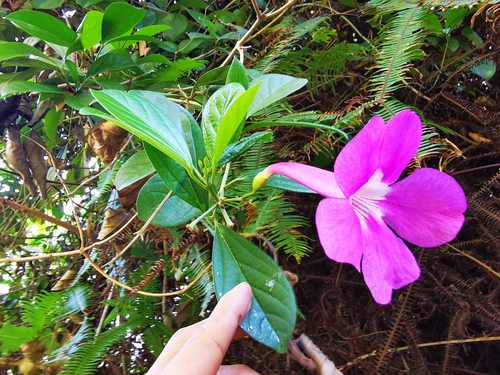
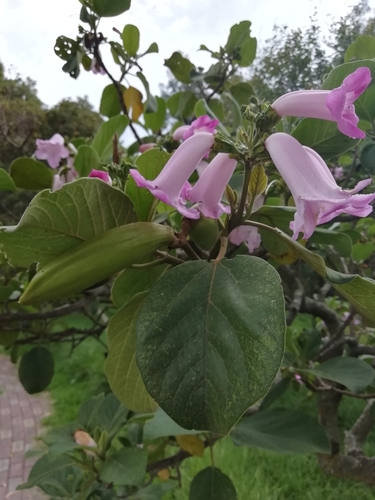
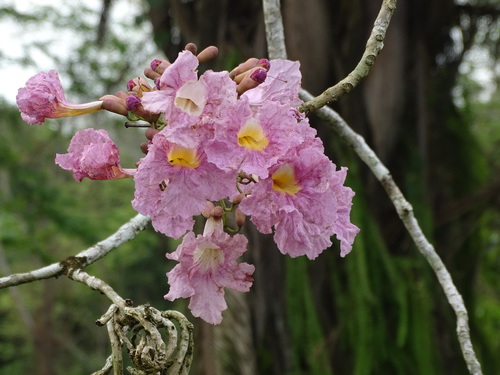
Tabebuia rosea is a short tree with irregular, stratified branching and only a few thick branches. Its bark ranges in color from gray to brown, can vary in darkness, and may be vertically fissured. It bears compound, digitate, deciduous leaves; each leaf has five leaflets of variable size, with the middle leaflet being the largest. Flowering occurs mainly in January and February, typically during dry periods, though it has also been observed in August, September, April, and May. Its flowers are large, occur in shades from pink to purple, and emerge when the tree has few or no leaves. Pollination is thought to be carried out by insects, though many birds including tanagers, hummingbirds, and orioles visit the flowers. Its long, slender fruit capsules can reach up to 35 cm (14 in) in length and develop from February through April. After drying, the fruit splits open to release anemochorous seeds, which are each equipped with a hyaline membrane wing. There are an average of 45,000 seeds per kilogram, with a water content of up to 13%. Seed germination is extremely easy and efficient, reaching almost 100%. This species is a fairly fast-growing tree. T. rosea is distributed from southern Mexico to Venezuela and Ecuador. It grows at elevations from sea level up to 1,200 m (3,900 ft), in areas with average temperatures between 20 °C and 30 °C, annual rainfall above 500 mm, and soils with a wide range of pH values. This tree is common in Neotropical cities, where it is often planted in parks and gardens: it provides shade in the rainy season, and produces abundant flowers on its defoliated branches in the dry season. Preparations made from the bark of this tree are consumed to eliminate intestinal parasites, treat malaria, and treat uterine cancer. A bark decoction is recommended for anemia and constipation. A decoction made from the flowers, leaves, and roots has been used to reduce fever and pain, stimulate sweating, and treat inflamed tonsils and various other disorders. One of the active phytochemicals found in this tree is lapachol, a natural organic compound that has also been isolated from other Tabebuia species. Chemically, lapachol is a naphthoquinone derivative related to vitamin K. While it was once studied as a potential treatment for some types of cancer, its therapeutic potential is now considered low due to toxic side effects. Lapachol also has antimalarial and antitrypanosomal effects.