About Syzygium cumini (L.) Skeels
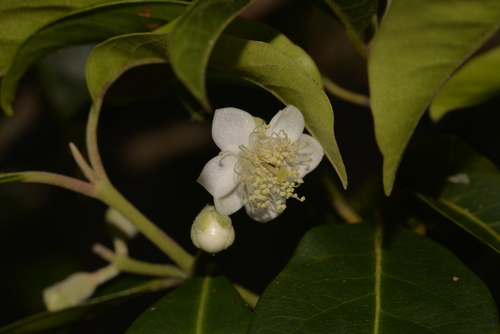
Syzygium cumini (L.) Skeels has dense foliage that provides shade, and the species is grown for its ornamental value. The bark is rough and dark grey at the base of the tree, and becomes lighter grey and smoother further up the trunk. Kiln-dried wood from this tree is water resistant. Due to this property, the wood is used to make railway sleepers and for installing motors in wells. It is sometimes used to make inexpensive furniture and village dwellings, though it is relatively difficult to work with for carpentry. Its aromatic leaves are pinkish when young, and mature into leathery, glossy dark green leaves with a yellow midrib. The leaves are used as livestock feed because they have good nutritional value. Syzygium cumini trees flower between March and April. Its flowers are small and fragrant, measuring approximately 5 mm (0.2 in) in diameter. Fruits finish developing by May or June, and resemble large berries. Fruits of all Syzygium species are described as "drupaceous". The fruit of this species is oblong or ovoid. Unripe fruit is green; as it matures, its color shifts to pink, then to a shining crimson red, and finally to black. One variant of the tree produces white-colored fruit. The fruit has a combined flavor of sweet, mildly sour, and astringent, and will usually turn the tongue purple. Syzygium cumini is native to the Indian subcontinent, including the Andaman Islands, Bangladesh, Nepal, India, the Eastern Himalayas, Pakistan, Assam state, the Laccadive Islands, and Sri Lanka; it is also native to China (Hainan province, South-Central and Southeast China), Indonesia (Java, the Maluku Islands, Sulawesi), Southeast Asia (Cambodia, Laos, Malaysia, Thailand, Vietnam and Myanmar), and Australia (Queensland). Jambolan fruits of this species have a sweet or slightly acidic flavor. They can be eaten raw, and may also be processed into sauces, jam, juice, jelly, sorbet, syrup such as kala khatta, or added to fruit salad. The 1889 book The Useful Native Plants of Australia notes that this plant, referenced under its synonym Eugenia jambolana, was called durobbi by some Indigenous Australians. Dietrich Brandis wrote of the plant that the fruit is commonly eaten by people native to India. In appearance it resembles a damson, with a harsh but sweetish flavor that is somewhat astringent and acidic. It is commonly eaten by birds, and is a favorite food of the large flying fox bat. A type of vinegar made from the fruit is used to treat diseases of the spleen. The fruit has also been used in traditional medicine.