About Syzygium aromaticum (L.) Merr. & L.M.Perry
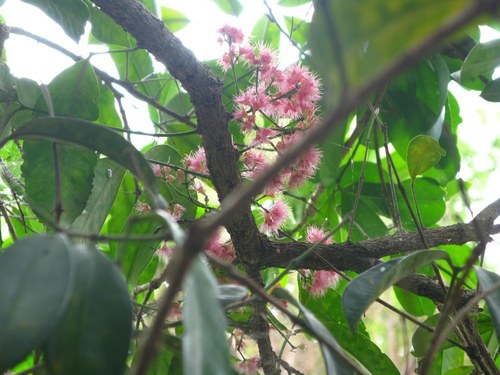
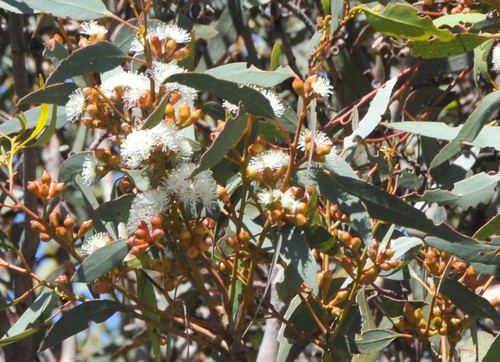
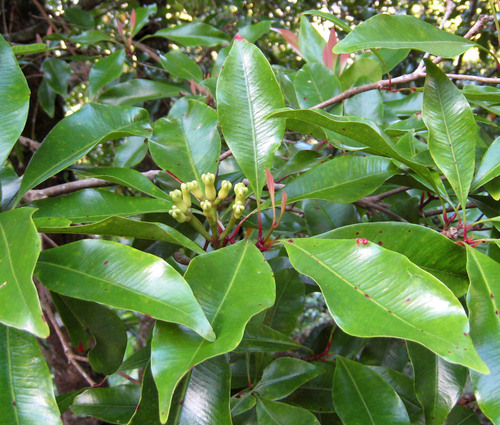
Syzygium aromaticum, commonly known as the clove tree, is an evergreen that grows 8–12 metres (26–39 ft) tall, with large leaves and crimson flowers grouped in terminal clusters. The tree's flower buds start pale, gradually turn green, and shift to a bright red when they are ready for harvest. Harvested cloves are 1.5–2 centimetres (5⁄8–3⁄4 in) long, and consist of a long calyx that ends in four spreading sepals, plus four unopened petals that form a small central ball. Clove stalks are the slender stems of the inflorescence axis, with opposite decussate branching. Externally, they are brownish, rough, and irregularly wrinkled lengthwise, with a short fracture and dry, woody texture. Mother cloves (anthophylli) are the ripe fruits of the clove tree: they are ovoid, brown berries, unilocular and one-seeded. Blown cloves are expanded flowers that have had both their corollae and stamens removed. Exhausted cloves are cloves from which most or all of the oil has been removed through distillation. No uses of clove for medicinal purposes have been approved by the US Food and Drug Administration, and oral use may cause adverse effects in people with liver disease, blood clotting disorders, immune system disorders, or food allergies. In traditional medicine, clove is used as an essential oil intended to act as an anodyne (analgesic), mainly for dental emergencies. There is evidence that clove oil containing eugenol is effective for relieving toothache pain and other types of pain. Clove essential oil may prevent the growth of Enterococcus faecalis bacteria, which can be present in unsuccessful root canal treatments. One review has reported that eugenol combined with zinc oxide is effective as an analgesic for alveolar osteitis. Studies testing the effectiveness of cloves or clove oil for reducing fever, acting as a mosquito repellent, and preventing premature ejaculation have been inconclusive. Whether cloves or clove oil reduce blood sugar levels remains unproven. Clove essential oil may also be used in aromatherapy. Cloves are widely used in cooking across the cuisines of Asia, Africa, the Mediterranean, and the Near and Middle East. They add flavor to meats such as baked ham, curries, and marinades, as well as fruits including apples, pears, and rhubarb. Cloves are also used to add aroma and flavor to hot beverages, often combined with other ingredients like lemon and sugar. They are a common ingredient in many spice blends; for example, they are part of the Malay rempah empat beradik ('four sibling spices') alongside cinnamon, cardamom and star anise, and they are also included in pumpkin pie spice and speculaas spice blends. In Mexican cuisine, cloves are known as clavos de olor, and are often paired with cumin and cinnamon. They are also used in Peruvian cuisine, in a wide range of dishes such as carapulcra and arroz con leche. Much of clove's characteristic taste comes from the chemical compound eugenol, so only small quantities of the spice are typically needed. It pairs well with cinnamon, allspice, vanilla, red wine, basil, onion, citrus peel, star anise, and peppercorns. Clove has a number of non-culinary uses. It is often added to betel quids to improve aroma during chewing. In Indonesia, the spice is used in a type of cigarette called kretek. Clove cigarettes have been smoked across Europe, Asia, and the United States. Since a ban on flavored cigarettes implemented in September 2009, clove cigarettes are currently classified as cigars in the United States. Clove essential oil may be used to inhibit mold growth on various types of foods. It can also be used to protect wood in systems for cultural heritage conservation, and studies have found clove essential oil to be more effective than a boron-based wood preservative. When combined with an orange, cloves can be used to make a fragrant pomander. When given as a gift in Victorian England, such a pomander signified warmth of feeling.