About Syrrhaptes paradoxus (Pallas, 1773)
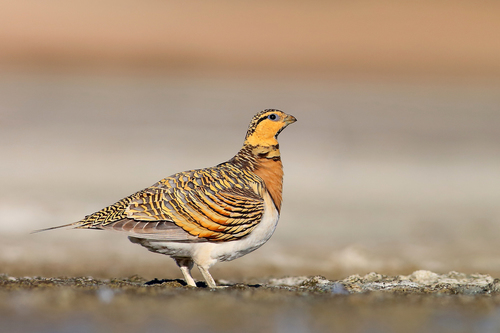
Pallas's sandgrouse, with the scientific name Syrrhaptes paradoxus (Pallas, 1773), measures 30–41 cm (12–16 in) in length. It has a small, pigeon-like head and neck paired with a sturdy, compact body, along with long pointed wings and tail. Its legs and toes are covered in feathers. The species has buff-colored plumage with barring on the upperparts, a distinct black belly patch, and pale underwings; the black belly and pale underwing separate this species from the closely related Tibetan sandgrouse. Male Pallas's sandgrouse can be identified by their grey head and breast, orange face, and grey breast band. Females have duller overall plumage, lack the breast band, and display more barring on their upperparts. The small feet have no hind toe, and the three front toes are fused together. The upper surface of the foot is feathered, while the underside has a fleshy pad, giving the foot an appearance more similar to a paw than a typical bird foot. This species breeds across the middle latitudes of central Asia, in dry steppes and similar open habitats. Its nest is a shallow scrape dug into the ground, where 2–3 greenish eggs with camouflaging cryptic markings are laid. It is a partial migrant, particularly moving away from the northern portions of its range in Kazakhstan and Mongolia; the extent and distance of its southward winter movement depends on snowfall levels. Pallas's sandgrouse occasionally irrupts beyond its regular breeding and wintering range as a vagrant across Europe, reaching as far west as Great Britain (where it has bred) and Ireland. The causes of these large, unusual movements are not fully understood, but such irruptions have become less frequent. This decrease is likely due to contraction of the species' western Siberian range as steppe habitats are converted for agricultural use.