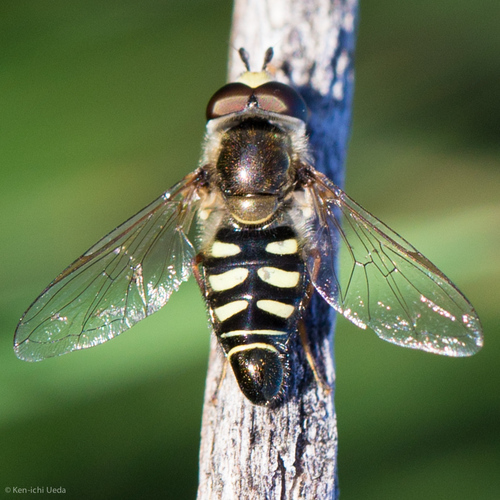
About Syrphus torvus Osten Sacken, 1875
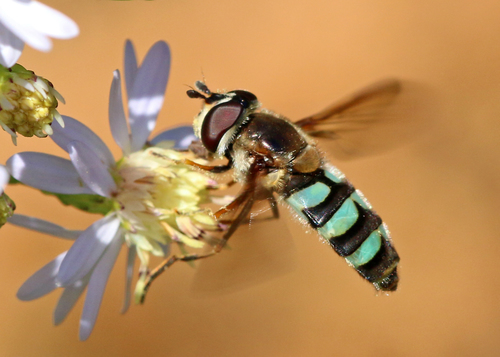
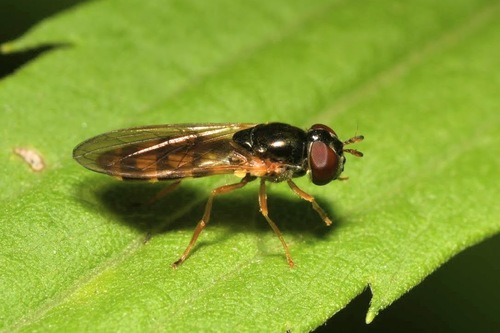
Syrphus torvus Osten Sacken, 1875. For terminology used in this description, see the Speight key to genera and glossary. External images of this species are available. The eyes of Syrphus torvus are covered in numerous hairs: in males, these hairs are long and dense, while in females they are shorter. The third femur is black over its basal three-quarters. Illustrations of the male genitalia and the larva of this species were published by Dusek and Laska in 1964. See references for help with species determination. This species is distributed across the Palearctic realm: it occurs from Greenland and Fennoscandia south through Europe to Iberia, the Mediterranean basin, Turkey, and European Russia. Its range extends east from the Urals through Siberia and the Russian Far East to the Pacific coast (including the Kuril Isles), and reaches Japan. It is also found in the Indomalayan realm, in Formosa, Northern India, Nepal, and Thailand. In the Nearctic realm, it ranges from Alaska southward to New Mexico. This species is migratory. Large numbers of this hoverfly species, along with Metasyrphus sp., have been observed on Denali in the Rocky Mountains at 5,000 metres (16,000 ft) altitude at the head of the Kahiltna Glacier.