About Syrmaticus reevesii (J.E.Gray, 1829)
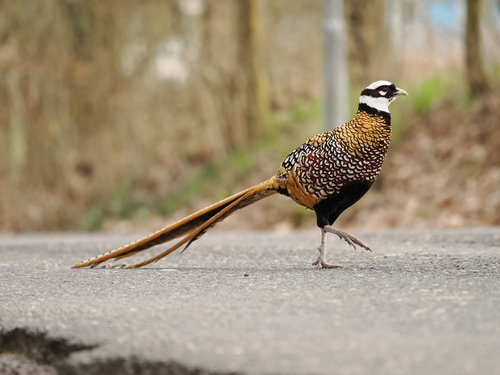
Males of Reeves's pheasant (Syrmaticus reevesii) measure 210 cm (83 in) long and weigh 1,529 g (3.371 lb). Males have bright plumage: their bodies have scaled golden white and red patterning, they have grey legs, a brown iris, and bare red skin around the eye. Their head is white, with a narrow black band across the eyes. Males also have an extremely long silvery white tail barred with chestnut brown. This species is listed in the 2008 edition of Guinness World Records for having the longest natural tail feather of any bird species, a record previously held by the crested argus pheasant. The male's tail can reach up to 2.4 m (7.9 ft) in length, and grows approximately 30 cm (12 in) each year. Females measure 75 cm (30 in) long and weigh 949 g (2.092 lb), which is around the same size as a male common pheasant. Female plumage is brown, with a blackish crown, a buff face, and greyish brown barred tail feathers. There are no recognized subspecies for this species, though some plumage variation exists between individuals. Reeves's pheasant is endemic to temperate evergreen and deciduous forests in central and eastern China. In regions where it has been introduced, it also lives on farmland adjacent to woodlands. The species has been introduced to the United States, Czech Republic, France, and the United Kingdom for sport and ornamental purposes. It is considered a valuable gamebird, because it prefers wooded hills that are not often used by native gamebirds, and it flies high when startled. In the United Kingdom, Reeves's pheasants were introduced to multiple estates across England, Scotland, and Ireland. While breeding was recorded at several sites, most introductions did not result in established, self-sustaining populations. Sporadic sightings occurred across the country, but by the late 1970s, only Woburn (Bedfordshire) and Kinveachy in the Caledonian Forest had significant breeding activity. By 2009, no areas had notable recorded reproduction of the species. The species' failure to establish persistent populations in the UK is attributed to two factors: males tend to wander away from their release sites, and their calls do not travel as far as the calls of other pheasant species, both of which interfere with successful reproduction. Additionally, Reeves's pheasants have interbred with large existing populations of common pheasants, which has diluted the genetics of the introduced stock.