About Syrmaticus humiae (Hume, 1881)
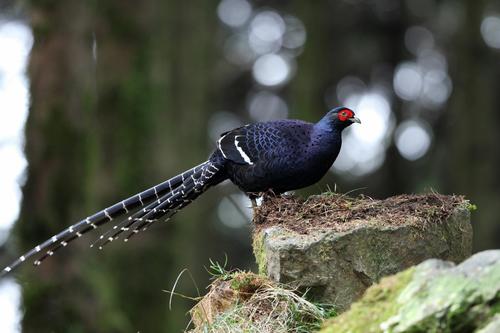
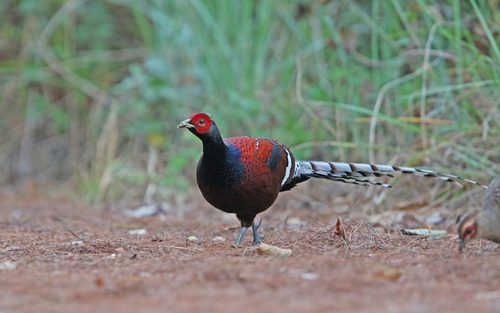
This species, commonly known as Mrs. Hume's pheasant, has a scientific name of Syrmaticus humiae (Hume, 1881). Adults reach up to 90 cm (35 in) in total length. Both sexes share a set of common physical traits: a greyish brown head, bare red facial skin, chestnut brown overall plumage, yellowish bill, brownish orange iris, white wingbars, and metallic blue neck feathers. Males have a long greyish white tail marked with black and brown barring. Females are chestnut brown overall, with a whitish throat, buff-colored belly, and a tail tipped with white. This is a rare, poorly studied pheasant that inhabits forested areas across Mizoram, the Patkai Range, Manipur, Yunnan, and northern Myanmar and northern Thailand. Its diet is made up primarily of vegetative matter. Females lay between three and twelve creamy white eggs, placed in nests constructed from leaves, twigs, and feathers. Due to ongoing habitat loss, a fragmented population, and hunting for food, Mrs. Hume's pheasant is classified as Vulnerable on the IUCN Red List of Threatened Species. It is also listed on Appendix I of CITES.