About Syritta pipiens (Linnaeus, 1758)
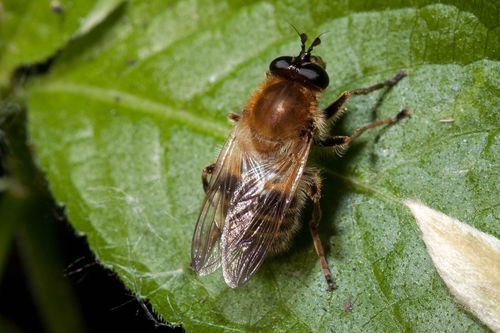
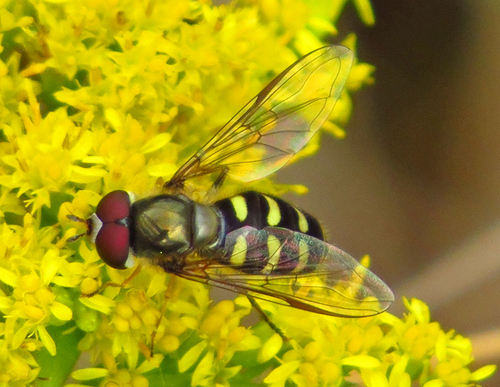
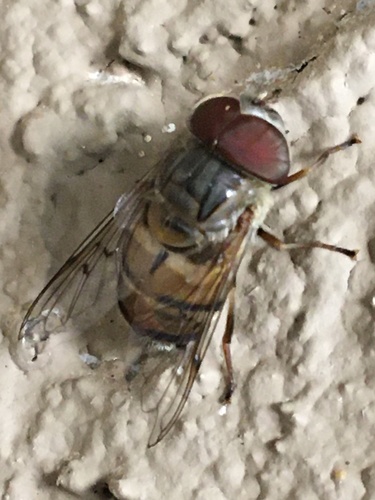
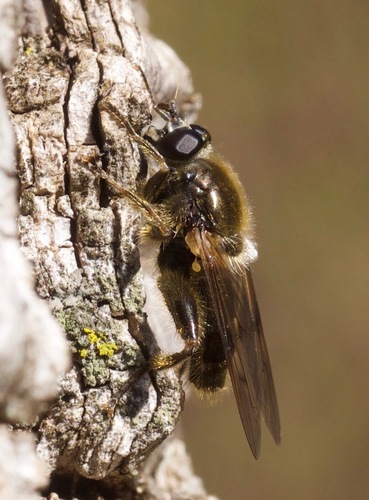
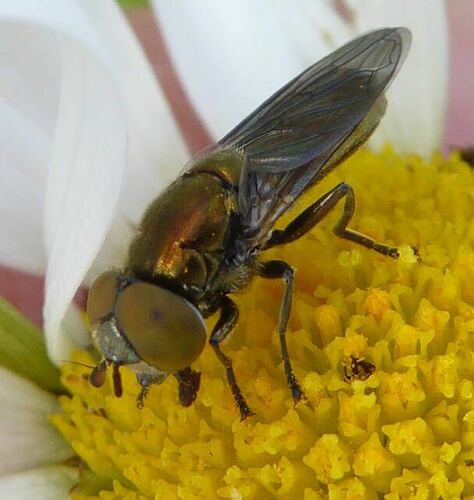
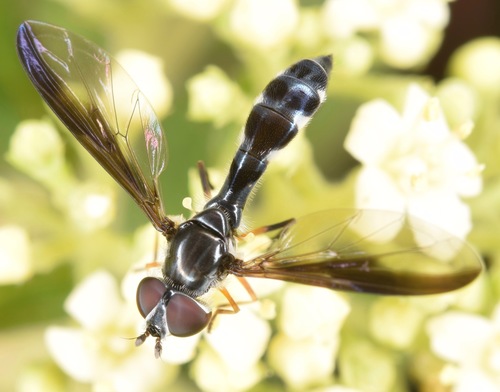
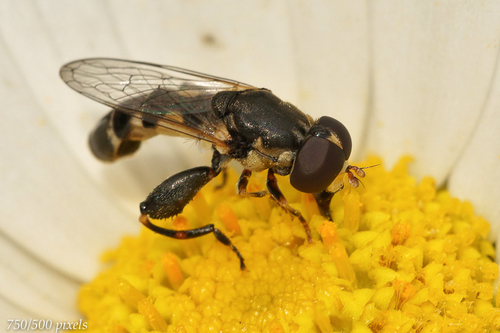
Syritta pipiens, commonly called the thick-legged hoverfly, is a species of hoverfly (also called flower fly) in the family Syrphidae. Syrphidae is one of the largest families in the order Diptera, holding around 6,000 known species that are widely distributed across the globe. These flies are distinctive and often found on flowers. Adult males of this species primarily feed on nectar, while adult females eat protein-rich pollen to produce eggs. The common name "thick-legged hoverfly" refers to the species' distinctively broad femora. Thick-legged hoverflies have a wing length of 4.25–7 mm (0.167–0.276 in) and a total body length of 6.5–9 mm (0.26–0.35 in). Both sexes have an apical third of the metafemur and a row of spines running along the ventral edge. One key distinctive morphological feature is a pair of small white wedge-shaped spots on the fly's thorax, located directly behind its head. In males, the third femur is strongly thickened, and has no basal protuberance. Tergites 2 and 3 bear small pale marks. Females have similar tergite markings, with a bluish-black, metallic sheen on the ocellar triangle. The side margins of the thorax dorsum are dusted, while the side and hind margins of tergite 4 are not dusted. See references for further species determination. The eyes of Syritta pipiens cover almost the entire surface of the head. Both sexes have similarly sized hemispherical heads, with a diameter of 2 mm. However, the eyes differ between the two sexes in two traits. First, males have holoptic eyes that meet at the front of the head, a common feature among male syrphid flies. Second, males have enlarged facets (fovea) between the clypeus and ocellar triangle, which are not present in females. Syritta pipiens was originally native to Europe, and was first introduced to North America and Asia in the 1800s. The species has a cosmopolitan distribution, found across all regions except the Afrotropical realm. It occurs anywhere that flowers grow, as it lives and feeds around flowers. It is also anthropophilic, and can be found in farmland, suburban gardens, and urban parks. In Ontario, active adults are seen from mid-April to mid-October. In most of Europe, most records document adult flight from March to November, but it is likely active year round in the warmer southern regions of Europe. Larval Syritta pipiens live in wetlands near freshwater bodies such as lakes, ponds, rivers, and ditches. Larvae of Syritta pipiens feed on decaying organic matter. Adult flies feed on the flowers of Dianthera americana (water-willow), Verbena urticifolia (white vervain), Phytolacca decandra (American pokeweed), and Stevia rebaudiana (candyleaf). They act as pollinators for Campanula rotundifolia (bluebell), a perennial herbaceous plant that produces blue flowers. Adults also visit flowers from the following genera and species: Achillea, Allium, Aster, Calluna, Cardamine, Cirsium palustre, Convolvulus, Crataegus, Epilobium, Euphorbia, Galium, Jasione montana, Leontodon, Polygonum cuspidatum, Potentilla erecta, Prunus laurocerasus, Ranunculus, Rosa canina, Senecio jacobaea, Sorbus aucuparia, and Tussilago.