About Syrigma sibilatrix (Temminck, 1824)
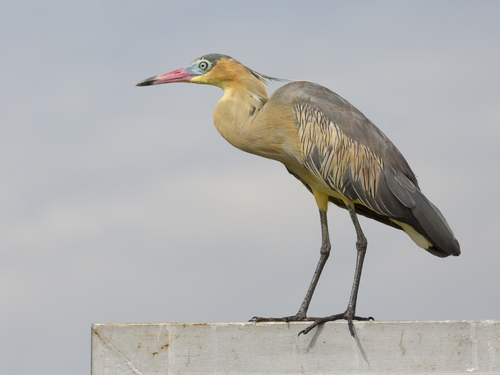
Syrigma sibilatrix, commonly called the whistling heron, measures 53 to 64 cm in total length and weighs 521 to 546 grams. The southern subspecies of this heron is larger than the northern subspecies, but has a shorter bill relative to its overall body size. Standing whistling herons give an overall impression of being gray, while flying individuals show highly visible white rear body parts: the lower back, belly, and tail. For both recognized subspecies, the adult upperparts (excluding the lower back) are blue-gray. Feathers on the sides of the head, sides of the neck, breast, and scapular region are fundamentally white, but stained to a gold or buff shade. This staining may come from the powder down that is typical of herons, or from secretions of the preen gland, and the intensity of the stained color varies between individual birds. In the nominate subspecies, the crown and separate nape crest plumes (which grow up to 4 cm long) are black, and the upper wing coverts are cinnamon-colored. In the subspecies fostersmithi, the crown and crest are slate-gray, and the upper wing coverts are honey-colored, also described as chamois. The whistling heron's bill is pink, with blue to violet coloring at the base and a black distal third. Its legs are greenish and fairly short, and there is a relatively large patch of bare bluish skin surrounding the eye. Juvenile whistling herons follow the same overall body pattern as adults, but have duller overall coloration: their crown is lighter, their breast is light gray, and their throat and body sides are unstained white. Chicks of this species have not been formally described. The species gets its common name from its most frequent call, which has been described as a loud, flute-like whistled kleeer-er; a high, reedy, complaining whistle, often doubled or produced in a series as wueeee, wueeee, that is easy to imitate; or a distinctive, far-carrying, melodious whistle that can be written as kee, kee, kee. The species may also give a slow, drawn-out whistle when taking off, and its alarm call is a harsh quah-h-h. Unlike most other heron species, the whistling heron uses fast, duck-like wingbeats during flight, and typically does not fully retract its neck while flying. The subspecies fostersmithi lives in the Llanos and Orinoco basin of Colombia and Venezuela. The nominate subspecies sibilatrix lives in eastern Bolivia, Paraguay, western and southern Brazil, Uruguay, Chile, and northeastern Argentina. Recent records indicate that the nominate subspecies may be expanding its range northward and eastward within Brazil. The species makes seasonal movements in at least northeastern Venezuela, where it is absent from November to January; it stays year-round in other areas, such as Buenos Aires Province, Argentina. The whistling heron occurs at elevations up to 500 meters, with one confirmed sighting recorded at 2300 meters. It inhabits seasonally flooded savanna, and often occupies drier grassy habitats than other heron species. It also lives in a wide range of open waterlogged or shallowly submerged terrain. Because it roosts in trees, it especially favors landscapes where open areas are mixed with woodlots. It readily uses human-altered habitats such as pastures and roadsides, and often perches on fenceposts. Although it has a patchy distribution, it is common across many areas, and no population of this species is considered vulnerable. It benefits from deforestation and some forms of agriculture. As a successful heron of dry tropical regions, it has been compared to two Old World species: the cattle egret and the black-headed heron.