About Syrichtus tessellum (Hübner, 1803)
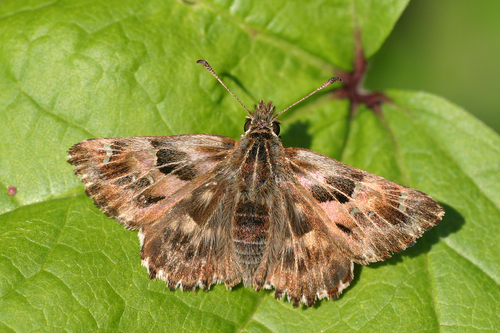
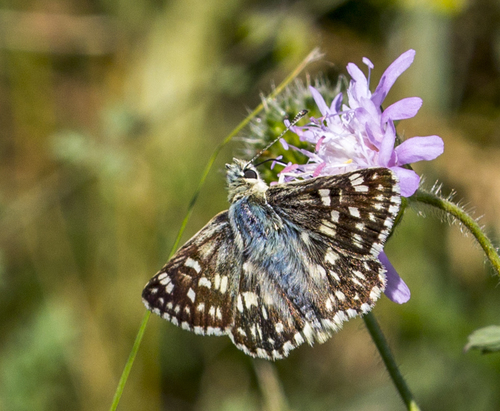
Scientific name: Syrichtus tessellum (Hübner, 1803), described in Seitz as H. tessellum Hbn. (85 e, f). The underside of the hindwing is grey-green or light olive, marked with three bands of light spots. The basal band, made up of two spots, ends in the cell; the median band is very broad, extending from vein 4 to vein 8; the white spot located between veins 3 and 4 projects strongly outward from the band. The forewing has four apical spots. This species ranges from Russia, through Anterior Asia, to West China, Tibet, and the Tian-shan. A newly described form, nigricans form. nov., collected from Juldus, is known from a single female specimen. In this form, the upperside of the wings is black; the median band of the forewing consists of only two spots, and the lunule at the apex of the cell is absent, leaving only three white dots and a diffuse smear in interspace 2 on the disc. The spots on the hindwing are reduced and obsolescent. The underside of both wings is nearly normal, but the center of the forewing is almost black, while the white spots on the hindwing are broader and all very sharply defined. Syrichtus tessellum ssp. nomas Lederer, 1855 (originally described as nomas Led.) (85 f) resembles the name-typical form on its upperside, but the underside of the hindwing is uniformly white and lacks markings. This subspecies occurs in South Russia, Asia Minor, Altai, and West China.