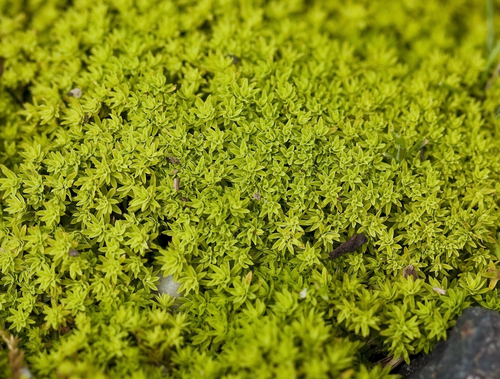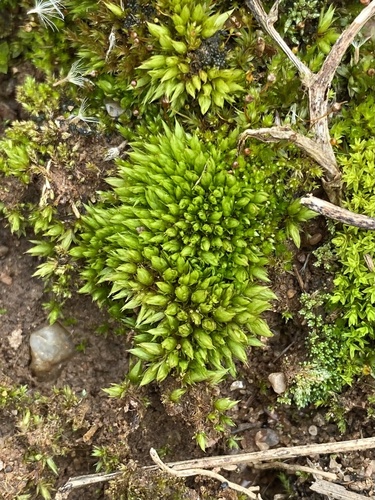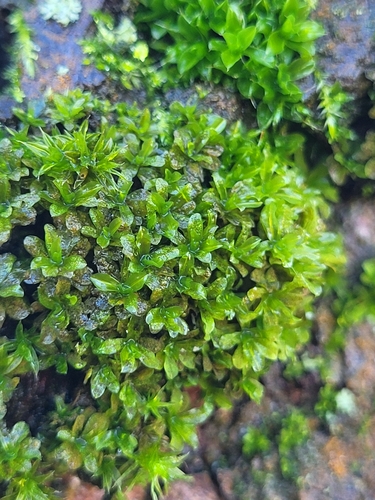
About Syntrichia latifolia (Bruch ex Hartm.) Huebener
Syntrichia latifolia, previously classified as Tortula latifolia, is commonly called water screw-moss. It is a moss species in the family Pottiaceae. Species in the genus Syntrichia can be distinguished from members of the genus Tortula by shared derived leaf traits: these include different basal and distal leaf cells, and different cross-sectional structures of the costa. Tortula has an abaxial epidermis on the costa, while Syntrichia lacks this layer. This moss is most commonly found in Europe and the Pacific Northwest region of North America. It grows on trees, sidewalks, and concrete. Syntrichia latifolia follows the standard moss life cycle with alternating haploid gametophyte and diploid sporophyte generations. When a haploid spore or gemma lands on a suitable surface, it germinates to form the haploid gametophyte. Germination first produces the protonematal stage, where rhizoids and protonematal filaments develop and anchor the organism to the substrate. Next, leafy gametophytic shoots develop. This species is dioicous, meaning a single mature gametophyte produces only either male antheridia or female archegonia, not both. A haploid sperm cell formed in an antheridium swims down the neck canal of an archegonium to fertilize the haploid egg inside, creating a diploid zygote. The sporophyte generation develops from this diploid zygote. The diploid seta elongates, and a diploid sporangium matures at its tip. Inside the sporangium, spores undergo meiosis to become haploid before they reach full maturity. When spores are ready to be released and the outer peristome teeth are dry, the spores are dispersed by wind.