About Synthliboramphus antiquus (J.F.Gmelin, 1789)
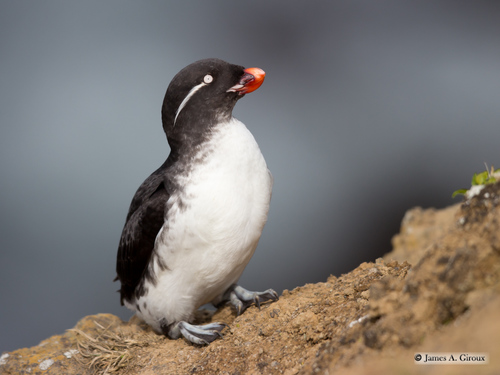
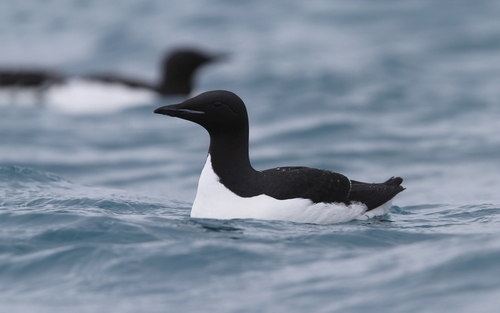
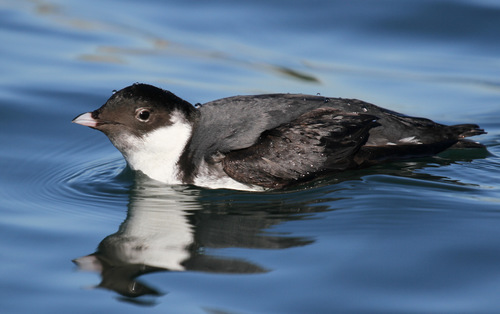
This small auk species has black plumage on the head, throat, and rear neck, grey upper back, and white underparts. Its bill is yellow, short, and stubby, and it has a small, rounded black tail. Adult birds in summer breeding plumage have white streaks on their heads, which create an aged appearance that inspired the species' common English name. Non-breeding plumages match breeding plumage in most ways, but lack the white crown streaks and the black coloring on the throat. Ancient murrelets typically bank from side to side while flying to a greater degree than other small auk species. They use fast wing beats during flight, which is due to their short wings. This species measures 20–24 cm (7.9–9.4 in) in length, weighs 150–250 g (5.4–8.8 oz), and has a wingspan of 45–46 cm (17.7–18.1 in). For breeding habitat, this species ranges from islands off China in the Yellow Sea, along the Russian Pacific coast and through the Aleutian Islands, to the Haida Gwaii archipelago of British Columbia; roughly half of the world's total population breeds in Haida Gwaii. Some individual ancient murrelets migrate 8,000 kilometres (5,000 mi) from Canada to winter near Japan and China, despite similar climate conditions at both the breeding and wintering areas. This is the only bird species known to cross the entire North Pacific. The birds begin their return northbound trip in February, flying four to five hours each day. Genetic evidence indicates that the species first originated in Asia, and only colonized North America relatively recently, so the annual migration brings the birds back to the species' original homeland. In 2007, surveys conducted off the Olympic Peninsula found an unprecedented number of Ancient Murrelets with chicks, which strongly suggests local breeding occurs in this area. Other ancient murrelets fly south for winter, reaching as far south as California. Rare stray birds can be found inland in North America after being carried there by autumn storms. The most notable record of this generally short-distance Pacific migrant is an individual found on Lundy Island, Devon, England, in spring 1990. Even more unusually, what is believed to be the same individual returned to this British island for the next two springs after the first sighting. In 2021, murrelets of this species were sighted in Finland.