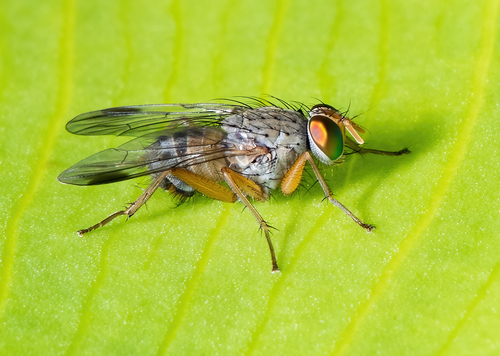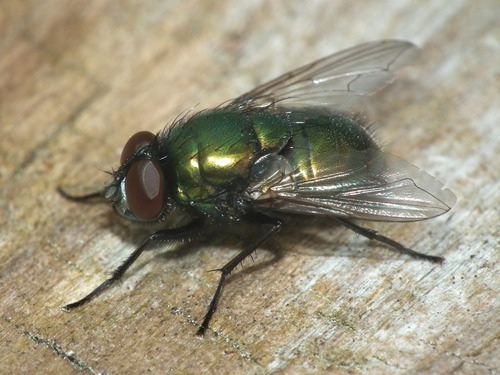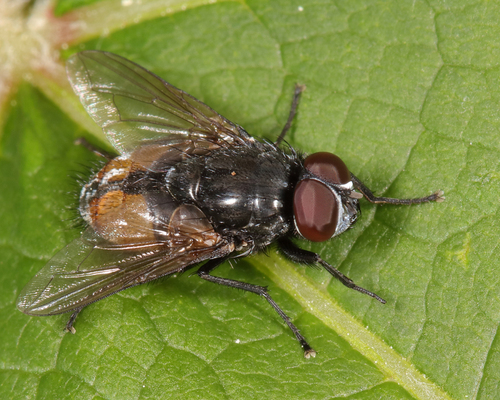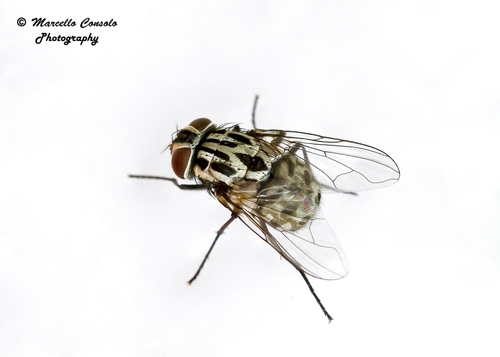
About Synthesiomyia nudiseta (Wulp, 1883)
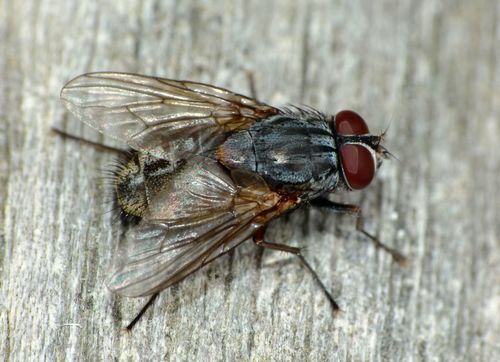
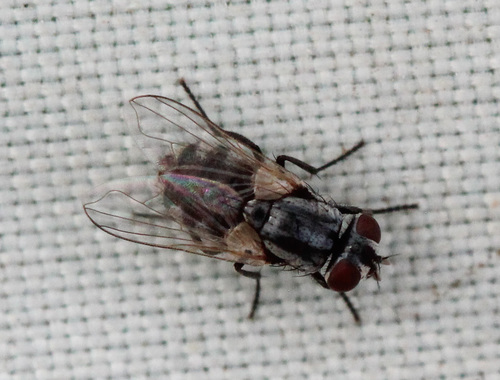
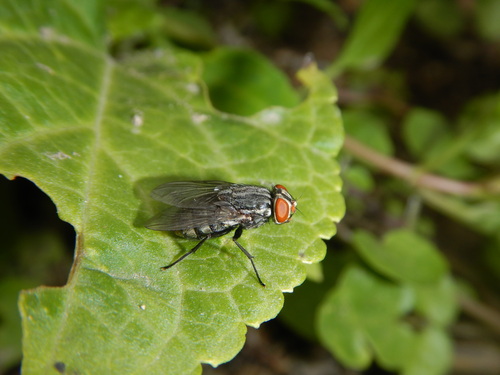
Synthesiomyia nudiseta (Wulp, 1883) is one of the largest species in the Muscidae (muscid) family, with adults reaching roughly 7 to 10 mm in length. The adult abdomen is gray with a checkerboard pattern, similar to that seen on flesh flies, which can lead to misidentification as a small sarcophagid. This species can be easily distinguished from sarcophagids by the four longitudinal stripes on its thorax, and by its yellow instead of red terminal abdominal segment. Its antennae and palpi are orange or yellow. On adult bodies, the posterior spiracles have S-shaped slits that allow air to enter the insect's trachea, and they also have a highly chitinized, complete peritreme. The larvae of S. nudiseta are large and predatory, and can easily consume C. rufiffacies. Premature third instar larvae have spiracular buttons, and each anterior spiracle holds five to seven papillae. Puparia are protected by an enclosing silky white substance. This species is closely related to the genus Muscina, differing primarily in the fine details of both larval and adult morphology and in their location. Common identifying features for adult muscid flies include a pair of antennae, three-segmented plumose aristae, a frontal suture, well-developed calypters, hypopleura without bristles, and more than one sternopleural bristle. The most unusual unique identifying feature of this species is the distinct parastomal sclerite in second instar larvae. This species is native to tropical and subtropical regions. In the United States, it is mainly collected between California and Texas, and between North Carolina and Florida. Adult flies prefer direct sunlight, and are most often found outdoors. In Europe, it is an introduced species, and has only been recorded in Portugal, Spain, and Italy. S. nudiseta is one of the first fly species to arrive at food sources to lay eggs, which are approximately 1.3 mm long. Its larvae develop more slowly than the larvae of other fly species that arrive alongside it, and its pupation occurs even later than pupation of these later-arriving fly species. The full life cycle from egg to adult lasts 22 to 30 days, and includes three larval instars. This species survives best in room temperature and warm environments, with an optimal survival temperature range of 25 to 31 degrees Celsius. It can produce 4 to 9 generations per year, with higher temperatures leading to a larger number of annual generations. The entire larval stage lasts approximately 13 to 15 days. Research has found the first instar developmental period is about 24 hours, the second instar period is longer at approximately 48 hours, and the third instar has the longest developmental period at 230 hours. First instar larvae measure 1.5 to 3 mm long, and have a much higher mortality rate than other species' first instar larvae, with only around 65% surviving past this instar. Second instar larvae measure 3 to 7 mm long and have very high viability. Third instar larvae measure 7 to 19.5 mm, and this stage is divided into two phases. In the first phase, larvae continue feeding and collect nutrients needed for pupation. In the second phase, third instar larvae begin searching for a suitable pupation site to enter the pre-pupal stage. During the pre-pupal stage, larvae excrete a silk-like white liquid from their salivary glands that solidifies into a sclerotized protective film, which forms the structure that will hold the puparium. The puparium is 7 to 8 mm in length, brown-red in color, and covered by a dirty white cocoon. Pupation typically occurs relatively close to the larvae's food source, as S. nudiseta larvae do not usually migrate very far. S. nudiseta larvae are one of the few species that can successfully pupate in confined locations. In addition to the protective cocoon, dust and soil particles coat the outer surface of the puparium, providing extra environmental protection.