About Synoeca surinama (Linnaeus, 1767)
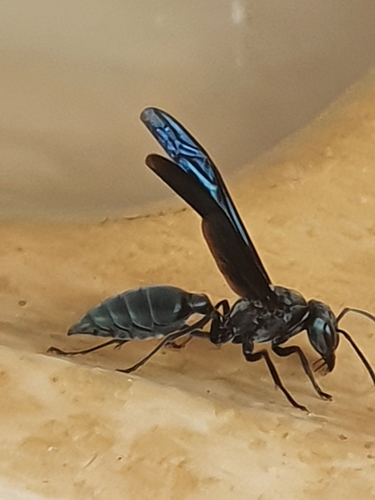
Synoeca surinama (Linnaeus, 1767) is a medium-sized wasp, colored bluish-black, and can appear metallic when viewed under certain lighting conditions. It has dark, almost black wings. Like all other members of the genus Synoeca, S. surinama has several distinct identifying traits, most notably a projecting vertex on its head.
Within the genus Synoeca, species vary in the concentration of punctation—small spots or markings—on the first abdominal segment, also called the propodeum. Unlike S. chalibea and S. virginea, which have dense propodeal punctation, S. surinama, S. cyanea, and S. septentrionalis have less punctation on both the dorsal and lateral surfaces of the propodeum.
Nests of S. surinama are constructed from short chip material, rather than the long fibers used by some other Synoeca species. The nest comb sits on an anchored pulp foundation, and the nest envelope is reinforced with blots. These nests do not have a secondary envelope, and the primary envelope is narrower at the bottom than at the top. Instead of a groove, S. surinama nests have a central dorsal ridge and a keel. Nest entrances are formed as a separate structure away from the final gap, have a short collar-like shape, and are positioned centrally toward the periphery of the envelope. Secondary combs are either absent or contiguous with the primary comb, and comb expansion happens gradually. Most nest cells are laid out before the envelope is closed during construction.
S. surinama occurs in tropical climate regions of South America. It is most commonly found in Venezuela, Colombia, Brazil, Guyana, Suriname—the country from which the species takes its name—French Guiana, Ecuador, Peru, and the northern parts of Bolivia. It occupies specific habitats including wet grassland, areas with scattered shrubs, areas with sparse shrubs and trees, and gallery forest. During the dry season, S. surinama nests on tree trunks within gallery forest, but forages across all four of these habitats, because it is robust enough to fly relatively long distances from its nest. It is one of the most common social wasp species in Central Brazil.