About Synoeca septentrionalis Richards, 1978
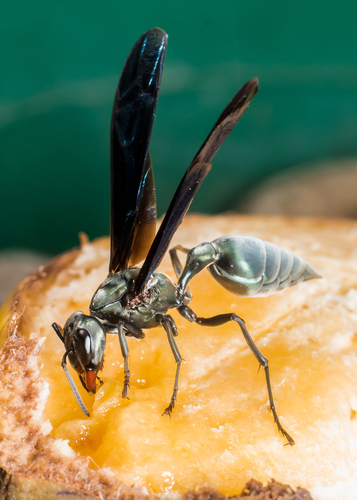
Synoeca septentrionalis is a medium-sized paper wasp, with individuals reaching approximately 20 millimetres (0.79 in) in overall length. This species is typically blackish or dark blue with a metallic appearance, though color patterns vary across individuals: some have reddish coloring, while others are fully darkened. Its wings are quite large and completely infuscate. Both the metasomal tergum, a section of the abdomen, and the metasomal sternum have erect hairs, and an area shaped like a dark triangle is imprinted on the clypeus. As paper wasps, S. septentrionalis constructs nests out of paper, and the structure of these nests changes as the wasp colony grows. New nests begin as one comb enclosed in a ridged, domed envelope with pre-placed holes that allow additional lobes to be added as needed. Most nests have only two to three lobes, but nests with up to nine lobes spanning over three meters have been recorded. Occasionally, some entrance holes are paired, and the combined perimeter of paired holes measures 10–12 centimetres (3.9–4.7 in). Certain holes remain open to serve as entrances and exits for the wasps. Synoeca septentrionalis is a Neotropical species native to Central and South America, with confirmed occurrences in Costa Rica, Panama, Colombia, Guatemala, Mexico, and Venezuela. Its range extends further north than the ranges of any other species in its genus. These wasps typically attach their nests flat to tree trunks or limbs, and recorded nests sit between 1.70 and 6 meters above the ground.