About Synodus lucioceps (Ayres, 1855)
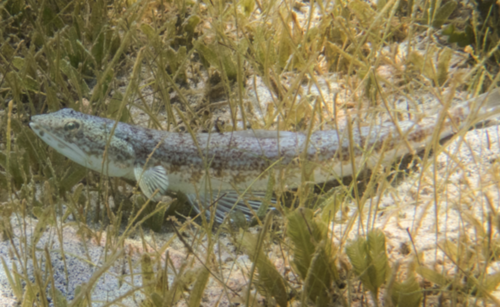
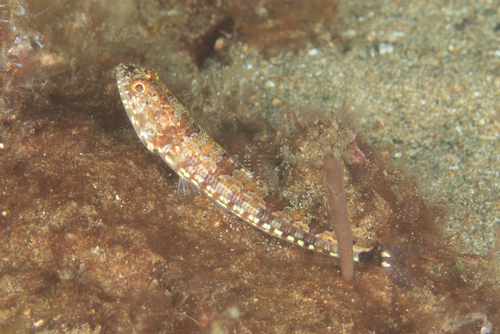
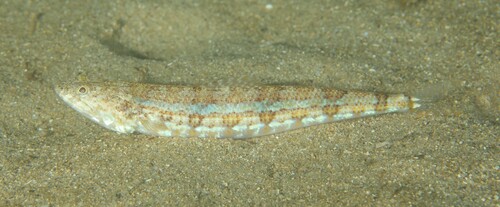
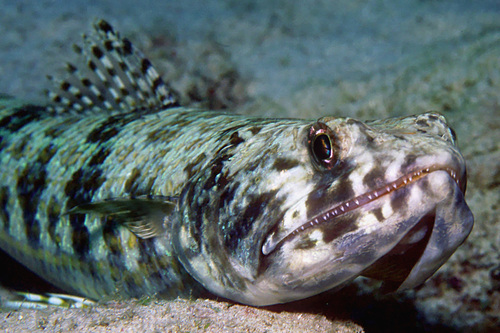
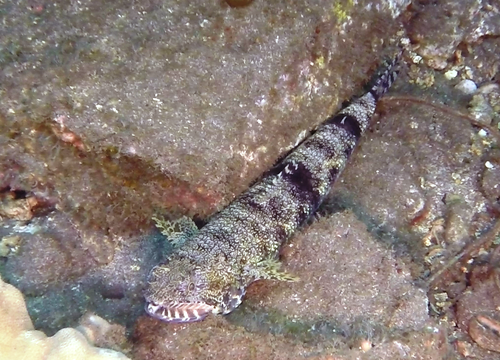
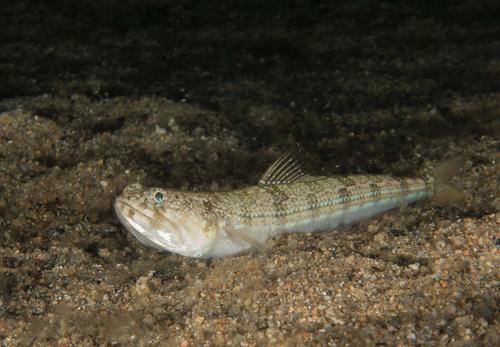
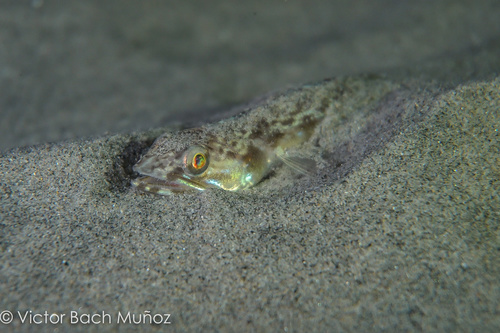
The California lizardfish gets its name from its elongated cylindrical body and lizard-like head and mouth. Its back is uniformly brown, with sides fading to tan and a white belly. It has a dorsal fin located on its midback, no spinous fin rays, a small adipose fin, yellowish pelvic fins positioned ahead of its dorsal fin that each have around eight or nine rays, and a forked caudal fin. The longest recorded California lizardfish was 25.17 inches (63.9 cm) long, and the species can weigh up to 4 pounds (1.8 kg). Due to its long body and sharp teeth, the California lizardfish is sometimes confused with barracuda. Barracuda, however, are silvery rather than brown and have two similarly sized dorsal fins separated by a wide gap, while the California lizardfish only has one dorsal fin with a tiny fleshy fin behind it. The California lizardfish is found from Guaymas, Mexico to San Francisco, California. A small number of specimens have also been found as far north as British Columbia, Canada and as far south as the Galapagos Islands. While the species is most commonly found on sandy bottoms in shallow water between 5 and 150 feet deep, individual specimens have been recorded at depths up to 750 feet. Most anglers do not target California lizardfish, as its flesh has a strong iodine-like taste. Uncommonly, fairly large numbers of California lizardfish are caught by anglers fishing for halibut and other shallow-water bottom-dwelling fish. California lizardfish will take most baited hooks.