About Synodus intermedius (Spix & Agassiz, 1829)
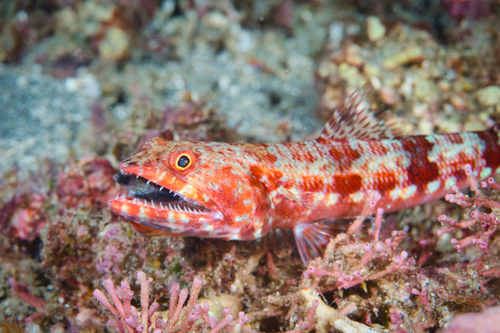
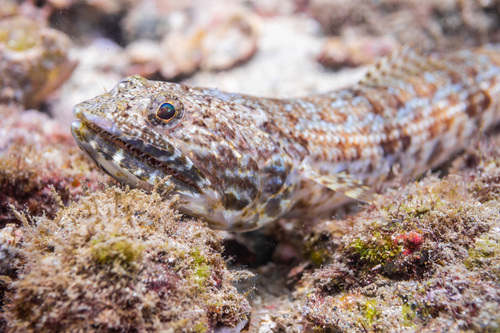
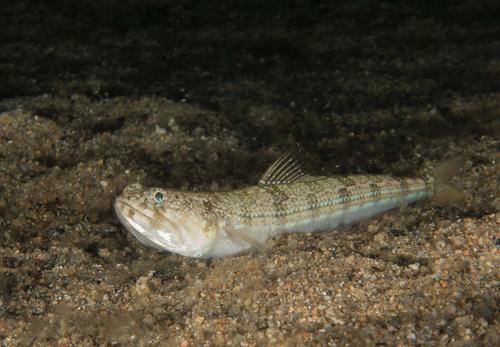
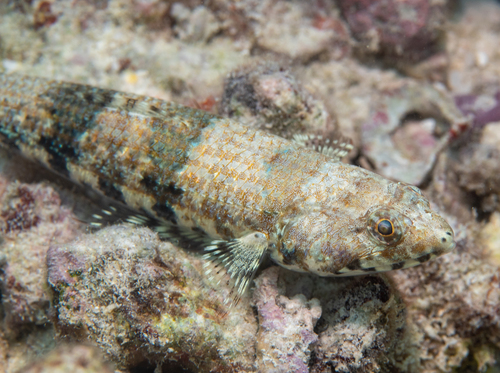
This species, commonly called the sand diver, has an elongated body and reaches a maximum length of 46 cm (18 in). Its dorsal (upper) surface is a dappled brownish-gray, with a black patch on the shoulder girdle at the upper end of the gill slits. There are around eight pairs of reddish-brown bars along the top and sides of the body; these bars are broadest at the lateral line and narrow toward the belly. Slender yellowish-gold longitudinal lines also run along the body, and the ventral (under) surface is pale.
Sand divers can be distinguished from similar species by several physical traits. The tip of the lower jaw is rounded and lacks a fleshy knob; the soft rays of the dorsal fin are relatively short, and when depressed, the tip of the front ray rests on top of the origin of the hind ray. This combination separates the sand diver from the offshore lizardfish (S. poeyi). The sand diver's anal fin has 10 to 12 soft rays, which distinguishes it from the otherwise similar diamond lizardfish (S. synodus), which has 8 to 10 soft rays. It may also be confused with the Atlantic lizardfish (S. saurus), but that species is uncommon in the Caribbean and has slender, blue or turquoise longitudinal lines instead of yellowish-gold.
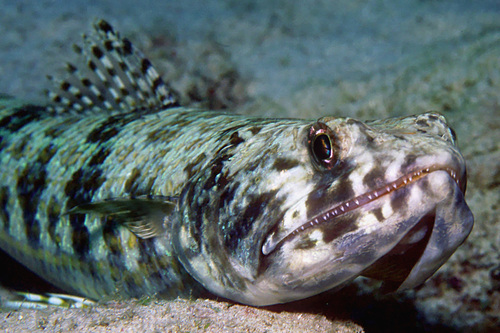
Like many benthic and demersal fish, the sand diver has an iridescent layer in the cornea of its eye, which may function to protect the eye from very bright light. It has a wide mouth filled with numerous needlelike teeth. There are two rows of teeth in the upper jaw, with teeth in the inner row longer than those in the outer row. The lower jaw has three rows of teeth: the outer row is covered by the lips, and teeth in the middle row increase in size toward the back. Both jaws have posterior teeth that slant slightly backward. There are three or four rows of depressible teeth on the palate, and the tongue has five rows of teeth, with the largest teeth positioned closest to the anterior tip and slanting toward the back.
Sand divers are distributed in the subtropical western Atlantic Ocean between 37°N and 17°N, including the Caribbean Sea and the Gulf of Mexico. Their range extends from North Carolina and Bermuda south to Santa Catarina in Brazil, and covers the West Indies, the Caribbean Sea, and the northern, eastern, and southern Gulf of Mexico. There is a questionable record of this species from São Tomé and Príncipe in the eastern Atlantic, and it is also known from the Philippines.
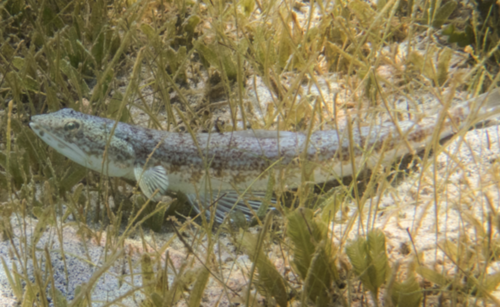
In terms of habitat, sand divers typically occur on or near the seabed in sandy areas around boulders, or in sandy corridors within reefs. They also rest on top of reef structures, propping themselves up with their pectoral fins. They can be found at depths down to 320 m (1,050 ft), but they rarely occur near shore, and most records are from depths between 38 m (125 ft) and 110 m (361 ft); divers have also recorded seeing them at depths of 20 to 80 feet on reefs in Bonaire.
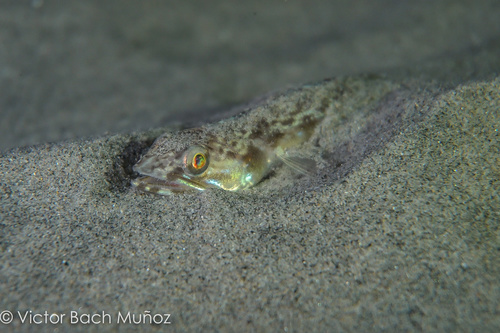
Ecologically, sand divers are piscivorous ambush predators. They were once thought to occupy a mid-trophic position as lie-in-wait predators, but are now known to occupy a high trophic position as active hunters that feed on other predatory fishes, and are considered apex predators in some ecosystems. They may rest on top of sand or reef tops, or bury themselves in sand with only their heads exposed. Their diet consists primarily of finfish and bony fish including bar jacks, wrasses, small grunts, and silversides, but they also feed on benthic crustaceans and cephalopods such as squid and cuttlefish.