About Synodus foetens (Linnaeus, 1766)
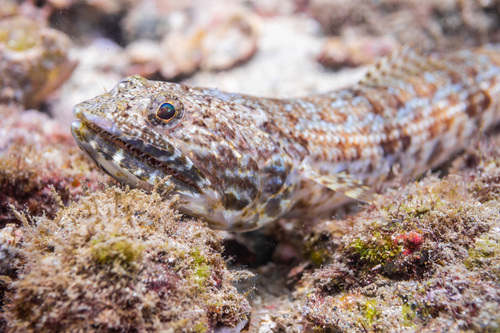
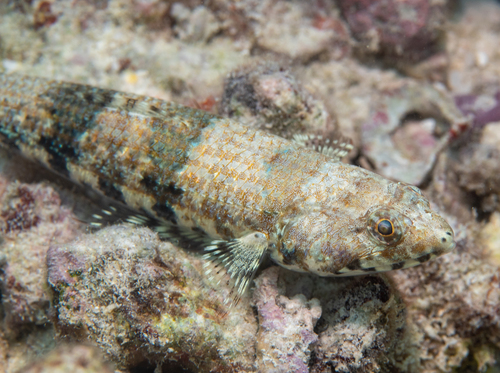
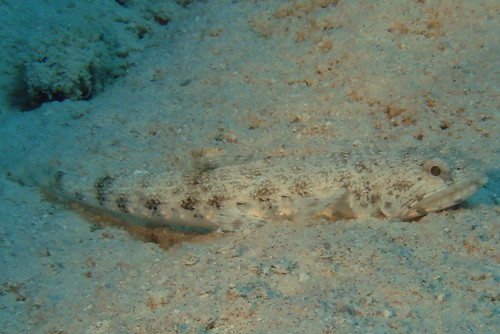
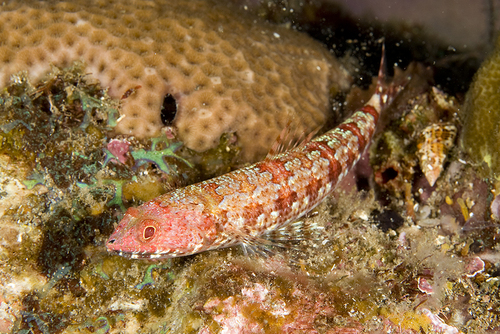
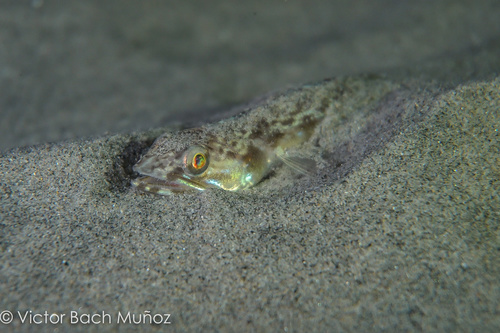
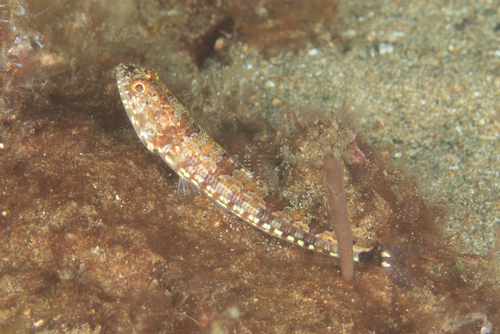
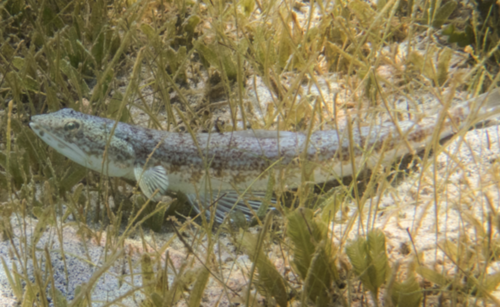
The inshore lizardfish, with the scientific name Synodus foetens (Linnaeus, 1766), has a recorded maximum length of approximately 50 cm (20 in), though 40 cm (16 in) lengths are far more common. Its maximum recorded weight is 900 g (32 oz), and the species can live up to nine years. Mature females are generally larger than mature males. This species has an elongated, cigar-shaped, thin body adapted for fast swimming, with a subcarangiform swimming style. Its head is slightly compressed with a wrinkled top, and the mouth is large, pointed, with a pointed snout where the top jaw extends past the eye. Inshore lizardfish rely on vision to detect prey from below, so they have large eyes with rounded pupils. Many slender teeth are present on the jawbones and the roof of the mouth, and the well-marked lateral line runs along roughly 60 scales along the body length. This species has no dorsal or anal spines, bears 10 to 13 dorsal soft rays, 11 to 13 anal soft rays, and 56 to 62 vertebrae. Compared to its body size, the inshore lizardfish has large dorsal and pelvic fins that help with steering, while a large, pointed caudal fin propels the fish forward. The dorsal side of the body ranges in color from various shades of brown to olive, and the belly ranges from white to yellow. Juveniles have dark spots that are reduced or completely absent in adults. Diamond-shaped patches appear on the sides of the fish, most often along the midlateral line; these patches vary in how often they occur and how intense their color is, and they typically fade as the fish grows. The dorsal fin sits in the center of the back, and a small adipose fin with a dark spot is present; the base of the adipose fin is no longer than the diameter of the fish's pupil. The anal fin is typically equal in length or longer than the dorsal fin. Inshore lizardfish larvae have slender bodies suited to navigating their habitat's variable environmental conditions, with small pointed snouts and large eyes; these traits help the species detect prey and monitor its surrounding environment. Inshore lizardfish live along the bottom of shallow inshore marine waters, most commonly over sand or mud bottoms. Their habitat includes creeks, rivers, seagrass beds, estuaries, bays, and lagoons. Adults can also be found in the open sea above continental shelves. This species occurs in water temperatures ranging from 8.3 °C (46.9 °F) to 31.7 °C (89.1 °F), and can tolerate a wide range of salinities from 1.9 parts per thousand to 60 parts per thousand. Habitat distribution is tied to body size: smaller inshore lizardfish live closer to shore, while larger individuals live further offshore. At the San Blas Archipelagos in Panama, the species is most abundant during the dry season. During these dry tropical periods, inshore lizardfish act as key members of their ecosystem and fill an important predatory role. They are abundant in tropical reef environments. The species' high tolerance for variable conditions that are harmful to many other fish species, along with its wide temperature and salinity tolerance, has been suggested to mean it can tolerate warming oceans and climate change. Its broad diet also suggests it has a large potential niche and could establish in a variety of new habitats if needed. The inshore lizardfish is widely distributed across soft-bottom inshore areas. It is found in the western Atlantic from New Jersey south along the U.S. coast, the northern Gulf of Mexico, Bermuda, the Bahamas, and the Caribbean in the waters around Cuba, Jamaica, Puerto Rico, and St. Martin. The species' adaptability to varied salinity and temperature conditions, plus its versatile diet, allow it to maintain large populations year-round. Due to its abundance, it is classified as a stable species with no threat of endangerment or extinction. Inshore lizardfish have external fertilization and spawn throughout the entire year. They do not guard their spherical eggs, which are scattered into the water column and protected by surrounding plants and rocks. As members of the family Synodontidae, this species has a lifestyle adapted to the variable waters of reef and shallow environments. It has a bipartite lifecycle, consisting of a pelagic larval stage and a bottom-dwelling, often reef-associated adult stage. The pelagic larval stage helps the species achieve its wide distribution, as larvae are moved by pelagic conditions including intense sunlight and choppy surface waters. Once larvae develop, the species transitions to a bottom-dwelling lifestyle to feed on crustaceans and benthic organisms. Late-stage inshore lizardfish larvae are photopositive (attracted to light), so researchers can use light traps to attract these larvae for study of the species' ecosystem distribution patterns. Late-stage larvae collected in light traps help scientists better understand the species' distribution patterns in its ecosystems.