About Synemon theresa Doubleday, 1846
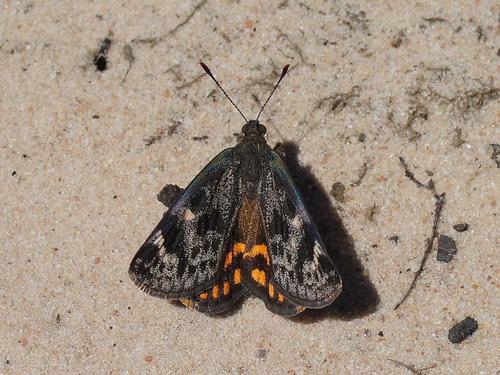
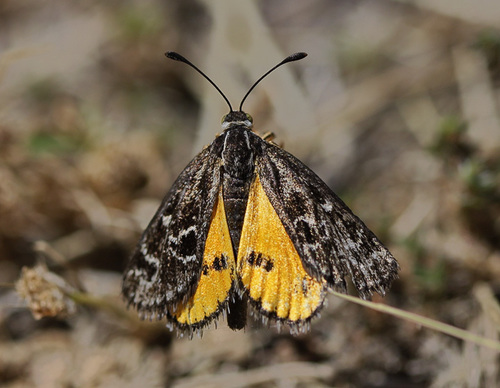
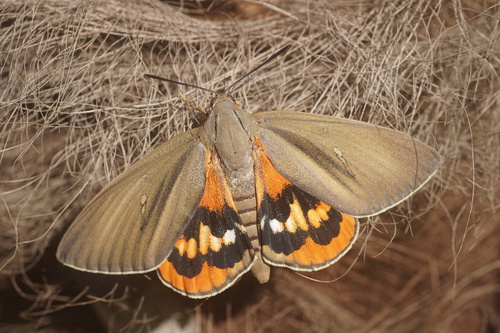
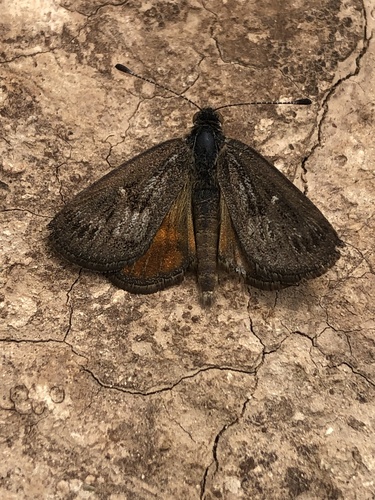
Scientific name: Synemon theresa Doubleday, 1846. Males have a wingspan ranging from 26 to 34mm, and females have a wingspan ranging from 30 to 40mm. The upper surfaces of the head, thorax and abdomen are grey, while their lower surfaces are whitish. The antennae are black with white rings. The upperside of the forewings is predominantly brown, with a whitish spot in the center. The underside of the forewings is mostly dull orange, with a row of small black spots along the outer edges. The upperside of the hindwings is dull orange, with a row of brown spots near the outer edges, and a brownish inner area that surrounds a dull orange spot. The underside of the hindwings is brownish-black with orange in males, and grey with orange in females; females also have a row of black spots near the edges of their hindwing undersides. This species has both dark and pale forms. Synemon theresa once occurred across a large portion of Victoria, with recorded sites including Castlemaine, Ararat and Beechworth. It has not been recorded in Victoria for over one hundred years, and is presumed extinct in this state. Currently, S. theresa can only be found in South Australia. While it was recorded near Clare in the 1960s, it is now believed to only occur in the western hills face area of the Mount Lofty Ranges, near Adelaide. It inhabits grassy open woodland that contains its larval food plants, which include Themeda triandra (kangaroo grass), Rytidosperma racemosum (narrow-head wallaby grass) and Rytidosperma caespitosum (common wallaby grass). This moth prefers native grass that is lightly grazed or mown and is in active green growth. Adult Cryptic Sun-moths are active from November to February. As is typical for the genus, they only fly during the daytime in sunny, warm to hot weather. Males are generally more sedentary, while females are more active, flying periodically through the habitat to search for males. Mating begins with a spiraling courtship flight. Females lay their eggs on the stems of host grasses near ground level, either by walking to the plant from the ground, or by moving down through the plant from the top. When first laid, the eggs are pale brownish-yellow, but turn white as larval hatching approaches. Eggs measure approximately 1.75mm by 0.65mm and have four longitudinal ridges. First instar larvae emerge after 19 to 20 days. Newly emerged larvae are around 2.3mm long and pale yellow. Like other Synemon larvae, they likely live in the root zone of host plants. Mature larvae and pupae of this species have not been formally described. Adult Cryptic Sun-moths do not have a feeding proboscis. They only live for a few days, surviving on fat stores accumulated during the larval stage.