About Synemon plana Walker, 1854
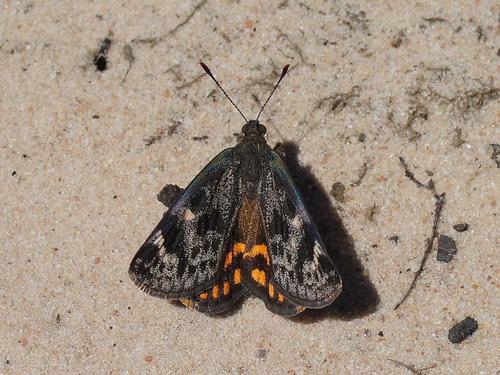
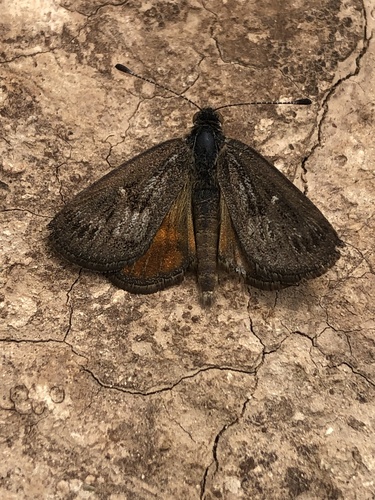
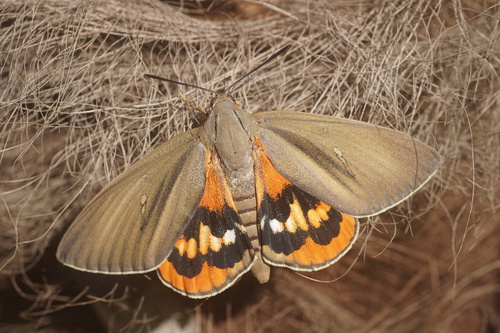
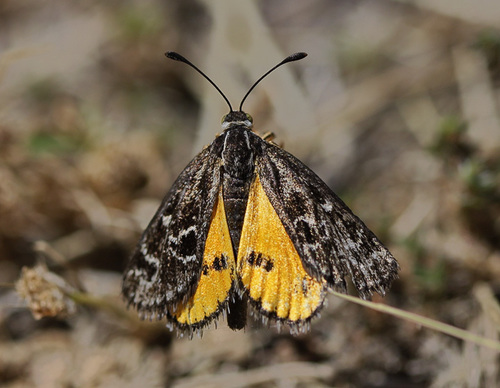
Synemon plana, commonly known as the golden sun moth, is a medium-sized day-flying moth. It has distinct green eyes and clubbed antennae, a notable feature that sets it apart from most other moths, which have brushy antennae. The species is listed as vulnerable under the EPBC Act 1999. It is closely associated with Rytidosperma (wallaby grass) species, and is almost entirely restricted to grasslands that contain many of these grasses. An optimal habitat for the golden sun moth requires at least 40% cover of Rytidosperma species. Males of the species have dull coloration: their forewings are dark brown patterned with pale grey, and their hindwings are brown with darker brown patches. Females are brighter in color. Their forewings have brown and grey patterns, while their hindwings are bright golden brown with dark brown patches along the outer margin. This golden coloring gives the species its common name. Females are generally flightless, with smaller hindwings compared to males. The golden sun moth is endemic to Australia, and is primarily restricted to south-eastern native temperate grasslands that have a high density of wallaby grasses (Rytidosperma spp.). At the time of European settlement, the golden sun moth had a wide, likely continuous distribution across native temperate grasslands and open grassy woodlands with dense wallaby grass populations. Historically, its populations occurred in New South Wales from Winburndale near Bathurst, across the Yass Plains, and south through large areas of the Australian Capital Territory. It was also historically recorded across vast areas of Victoria surrounding Bendigo, Mansfield, Eildon, Nhill, Williamstown and Salisbury, extending to Bordertown in South Australia. Today, only around one percent of the original two million hectares of native temperate grasslands remain, due to agricultural conversion, and much of the remaining area is dominated by weeds. Current golden sun moth populations are reduced and highly fragmented, with 125 known sites recorded across its range after 1990. Of these sites, 48 are in New South Wales, 45 are in Victoria, and 32 are in the Australian Capital Territory. Most of these populations occupy areas no larger than 5 hectares. Potential habitat for the moth includes any area that has, or once had, grassy woodlands or native grasslands within the species' historical range. The golden sun moth is known to inhabit substantially degraded grasslands, including those dominated by the introduced Chilean needlegrass (Nassella neesiana). Two threatened ecological vegetation communities listed under the EPBC Act are known habitats for the moth: the ‘Natural Temperate Grassland of the Southern Tablelands of NSW and the ACT', and the ‘Natural Temperate Grassland of the Victorian Volcanic Plain’. The golden sun moth's life cycle is relatively well understood. Longevity was estimated at about two years by Edwards in 1994, but genetic evidence from Clarke in 1999 suggests generation time may actually be 12 months. After mating, females are believed to lay up to 200 eggs at the base of Rytidosperma tussocks. Eggs hatch after 21 days. Larvae tunnel underground to feed, before digging a vertical tunnel to the surface, where the pupa stays for six weeks until maturation. Adult moths emerge from the soil between late October and mid-January, and are only active during the hottest part of the day; most males are only active at temperatures above 22 °C. The larval stage is spent underground for two to three years, during which larvae feed on the roots of native perennial grasses including speargrass (Austrostipa spp.), wallaby grass (Rytidosperma spp.) and Bothriochloa. This conclusion is based on evidence of pupal cases and tunnels connecting to nearby tussocks. Recent discoveries indicate larvae may also feed on introduced grass species, as cast pupa shells have been found protruding from tussocks of the introduced Chilean needle grass (Nassella neesiana). The immature stages of the golden sun moth have not yet been described. Variation in the length of the larval stage may give populations the flexibility needed to survive harsh years. When females emerge as adults from their tunnels, they already have fully developed eggs. They then begin searching for a mate, flashing their vivid orange hindwings to attract patrolling males. Adults only live for one to two days, as they lack functional mouthparts and cannot feed.