About Syneilesis hayatae Kitam.
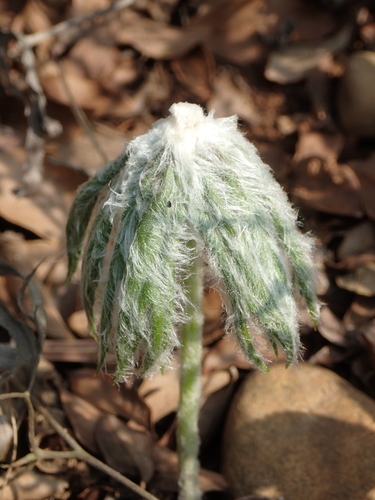
Syneilesis hayatae Kitam. is a medium to large completely glabrous herbaceous plant, reaching heights of 80 to 160 cm. Its leaves are subcoriaceous, and gradually elongate from the plant base to the upper internodes. Basal leaves are peltate-ovate, around 35 cm in diameter, with long petioles and peltate attachments. The leaf blade is palmately deeply lobed, resembling an upright umbrella standing on the ground. The lobes typically number 5 to 9, and are bifid one or two times, with an acute apex and irregularly incised serrations along the leaf margin. Cauline leaves on the upper part of the plant are smaller in size, have shorter petioles, narrower leaf blades, and less distinct leaf lobes. Its light pink inflorescences are arranged in corymbs along the inflorescence axis. A single flower head contains approximately 14 to 16 tubular flowers, surrounded by two whorls of involucral bracts. The corolla of an individual flower is five-lobed and white, and its pedicel measures 5 to 16 mm in length. This species shares the same genus with another Taiwan endemic plant, Syneilesis subglabrata. The two can be reliably distinguished by their geographic distribution, inflorescence structure, and leaf lobe morphology. Syneilesis hayatae is only found in lowland grasslands of Miaoli, has robust plant growth, corymbose flower heads, and shallower leaf margin serrations that approach simple serrated margins. Syneilesis subglabrata is endemic to the mountainous regions of central Taiwan, growing under forest canopy at altitudes between 1200 and 2800 meters. It has a slender growth habit, conically arranged flower heads, and deeper leaf margin serrations that approach leaf lobes. The genus Syneilesis is a group of Asteraceae species endemic to East Asia. There are 6 known species worldwide, with two species found in Taiwan, both endemic to the island. Syneilesis hayatae is restricted to open grasslands at altitudes of 300 to 500 meters in Miaoli, growing mostly on lowland hills or in cemeteries.