About Synchiropus splendidus (Herre, 1927)
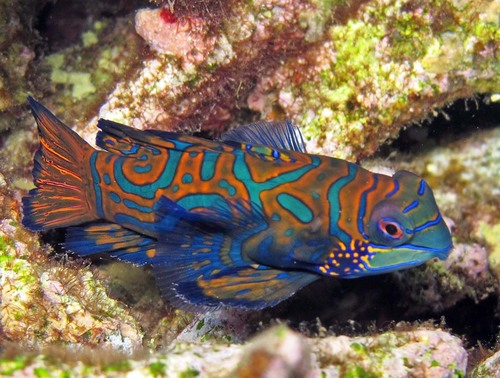
Synchiropus splendidus (Herre, 1927), the mandarinfish, is one of only two vertebrate species known to get its blue colouring from cellular pigment; the other is its close relative, the psychedelic mandarin (S. picturatus). The term "cyanophore" was proposed for these blue chromatophores, which are the pigment-containing and light-reflecting cells that produce this blue colour. In all other known vertebrates, blue colour is structural, generated by thin-film interference from stacks of flat, thin, reflective purine crystals. The mandarinfish shares only a goby-like body shape with gobies, with no other similarities between the two groups. Its vivid coloration has a bright blue base, with swirly orange stripes and a blue-green face marked by bold blue stripes. Its large pelvic fins are used to "walk" across the seafloor, and are often mistaken for pectoral fins. The true pectoral fins are located almost at the center of the body and are nearly transparent, with a slight tint. The anal fins, part of the tail, and the rest of the body are striped in vibrant orange and blue. The dorsal fin is exceptionally tall in males, and also has a striking orange-and-blue pattern. The mandarinfish's eyes are usually red with black pupils. Different varieties of the species have different markings and colours. The green mandarin morph matches the general colour description above. The red mandarin is the same species, but its pelvic fins and the regions that are orange in green mandarins are red. In rare cases, entire individuals can be red with black stripes. The spotted mandarin morph is light gray-green with black, pink and blue spots. Mandarinfish are reef-dwelling fish that prefer sheltered lagoons and inshore reefs. Though they are slow-moving and fairly common across their range, they are not easy to spot due to their bottom-feeding habits and small size, reaching only around 6 cm in length. They feed primarily on small crustaceans and other invertebrates.