About Syncarpia glomulifera (Sm.) Nied.
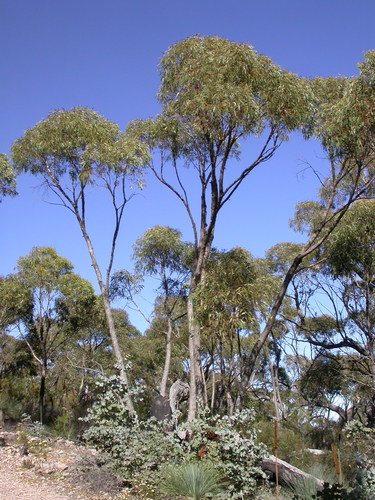
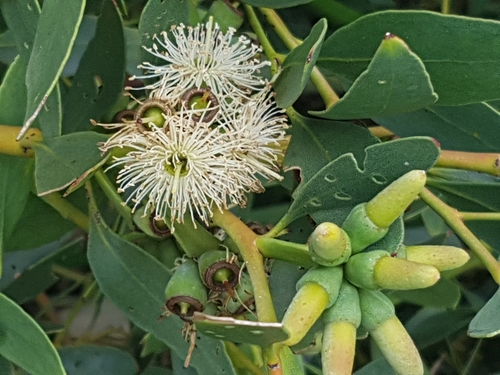
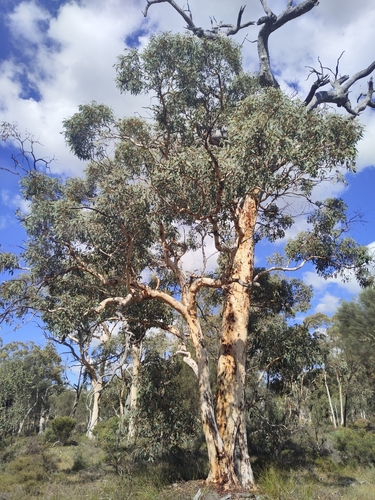
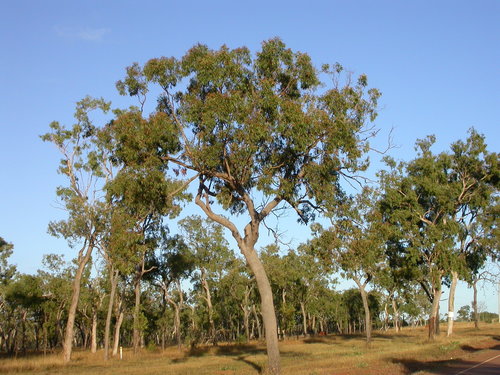
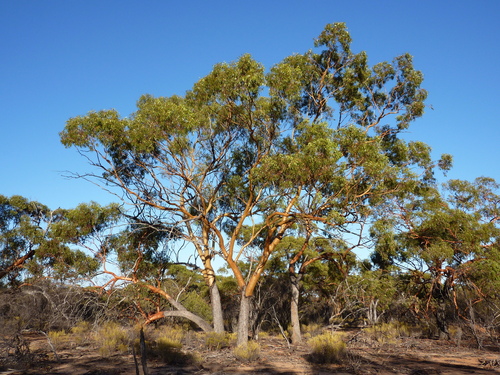
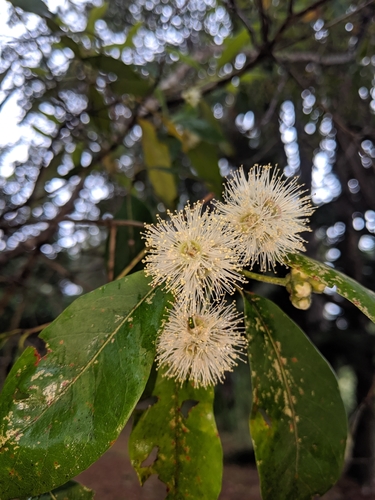
Syncarpia glomulifera, commonly known as turpentine, is a large tree when growing in suitable conditions. In ideal locations, it develops a large straight trunk reaching 45 to 55 m (150–180 ft) in height, with a diameter at breast height (DBH) of up to 1.3 to 1.5 m (4–5 ft). On poorer quality soils, it grows as a small tree or even develops a mallee growth habit. The trunk is covered in thick brown fibrous bark marked with deep vertical furrows. Leaves are arranged oppositely along stems; pairs grow close enough together that they appear to form a whorl of four leaves. The thick leaves sit on 0.7–1.3 cm long petioles, are oval to elliptical in shape, and measure 7–10 cm (3–4 in) long by 2.5–4.5 cm (1–2 in) across, with recurved margins. The upper leaf surface is dull dark green, while the lower surface is much paler; subspecies glomulifera has fine hairs on the lower leaf surface, while subspecies glabra has a smooth lower surface. Flowering occurs between August and December, with peak flowering in September. The cream flowers are fused in groups of seven into compound flowerheads. After flowering, compound woody capsule fruits 1 to 2 cm (0.39 to 0.79 in) in diameter develop and ripen over summer. Turpentine is distributed across eastern Queensland and New South Wales, Australia, ranging from Atherton in the far north to Murramarang National Park in the south. North of Gympie, its distribution is fragmented, with separate colonies located on the Blackdown and Consuelo Tablelands, in the Tinaroo district, and on the Windsor Tableland. Its most common habitat is transitional forest between rainforest and wet sclerophyll forest, where it grows as an emergent tree alongside species including flooded gum (Eucalyptus grandis), tallowwood (E. microcorys), grey ironbark (E. paniculata), white stringybark (E. globoidea), yellow stringybark (E. muelleriana), white-topped box (E. quadrangulata), rough-barked apple (Angophora floribunda), brush box (Lophostemon confertus), various rainforest species, spotted gum (Corymbia maculata), and blackbutt (Eucalyptus pilularis). On poorer soils, it grows much smaller in dry sclerophyll forest alongside smooth-barked apple (Angophora costata) and yellow bloodwood (Corymbia eximia). Turpentine is adaptable to a wide range of soils, but grows best in moderate to high-nutrient soils such as the clay soil over Wianamatta shale found in the Sydney region. Valleys and flat areas are highly suitable growing sites. In the Sydney region, the species occurs up to 300 m (980 ft) altitude, while in northern Queensland it can be found up to 900 m (3,000 ft) above sea level. It is one of the dominant species of the critically endangered Sydney Turpentine-Ironbark Forest ecological community. The largest known turpentine grows near the Williams River Recreation Reserve in Barrington Tops National Park, New South Wales; this individual has a trunk circumference of 7.90 m (26 ft) at breast height, reaches 58 m (190 ft) in height, has a crown spread of 20 m (66 ft), and scores 517 points when calculated with the National Register of Big Trees formula. Turpentine flowers are pollinated by native bees, European honeybees, and possibly also flies and moths. Grey-headed flying foxes (Pteropus poliocephalus) and little red flying foxes (Pteropus scapulatus) also pollinate the flowers. Rainbow lorikeets (Trichoglossus haematodus) and noisy miners (Manorina melanocephala) forage on the tree's nectar. Turpentine regenerates after bushfire by resprouting from its lignotuber and epicormic buds, and individuals are thought to live up to 500 years. The highly durable timber of turpentine is used for heavy-traffic flooring, poles, and wharves. It resists damage from marine invertebrates and termites, and is one of the most difficult timbers to ignite. As a hardy, adaptable tree, turpentine tolerates heavy soils and frosts, and is well-suited for planting in large gardens and parks, where it provides good shade with its dense canopy.