About Synanthedon myopaeformis (Borkhausen, 1789)
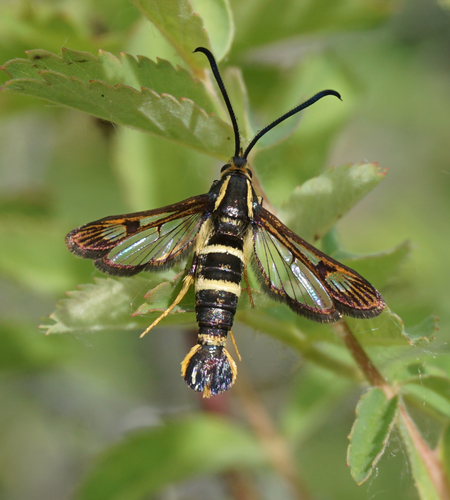
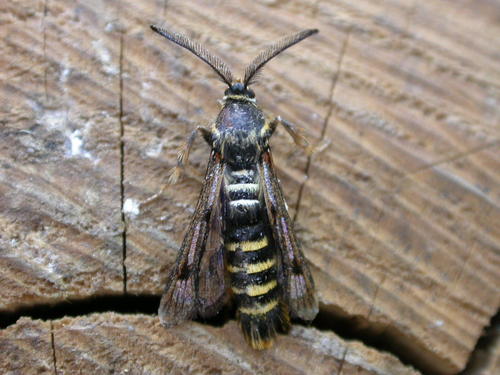
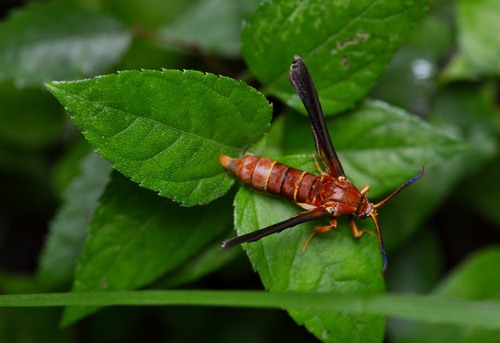
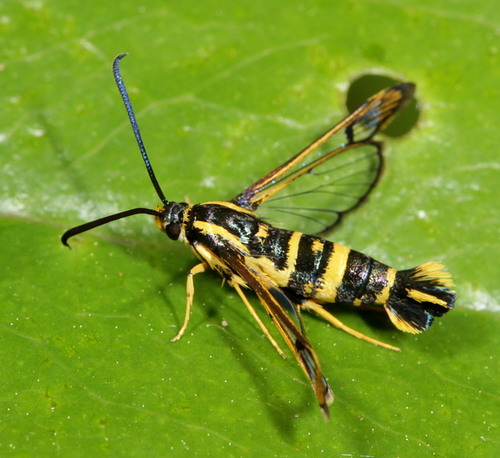
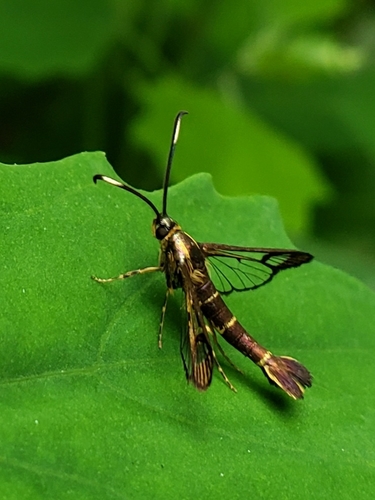
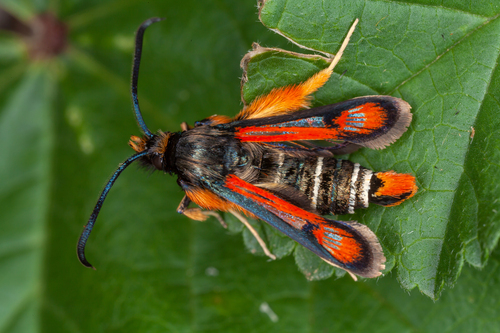
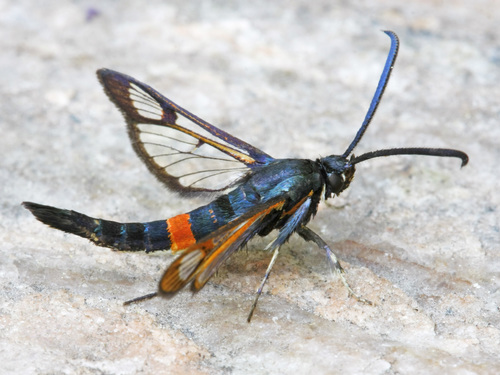
This species has the scientific name Synanthedon myopaeformis (Borkhausen, 1789). For morphology, adult moths are blue-black with a dark orange-red stripe across their segmented abdomen, and have short, bushy tails. Their wings have clear centers, dark edges, and a short fringe along the edges. Forewing wingspan ranges from 1.8 to 2.8 cm, and forewings are narrower and longer than hindwings. Fully grown caterpillars reach 2.5 cm in length, with off-white bodies and reddish-brown heads. Pupae are approximately 1.5 cm long, golden brown, and have two short protruding projections called tubercles on their heads. Pupae can often be seen sticking out from the bark of apple trees. This moth is native to north Africa, western Asia, and Europe, where it is called the red-belted clearwing moth. It was first discovered in southwestern Canada in 2005, and has since been recorded in the United States. Across North America, it is called the apple clearwing moth because it is a pest of apple trees. Because its entire life cycle depends on host trees, Synanthedon myopaeformis occurs predominantly near apple orchards. It can also be found in gardens, woodlands, and hedgerows. Larvae feed under the bark of apple trees, crab apples, pears, quinces, plums, cherries, apricots, hawthorn, and mountain ash, and prefer older cankerous host trees. In Canada, researchers have found that both male and female moths are attracted to the flowers of showy milkweed (Asclepias speciosa). This attraction is caused by phenylacetaldehyde produced by the flowers, and this compound can be used to monitor moth populations or trap them in large numbers.