About Synanthedon formicaeformis (Esper, 1783)
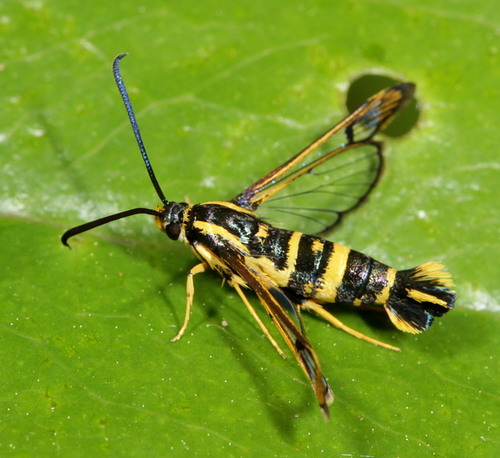
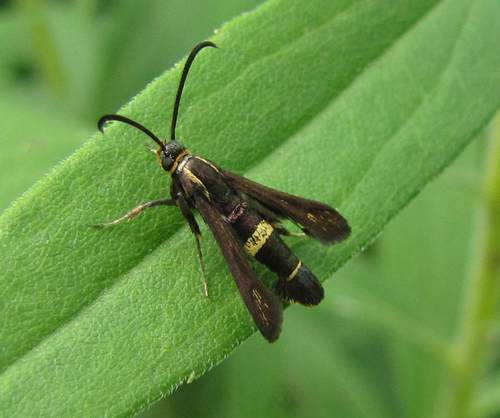
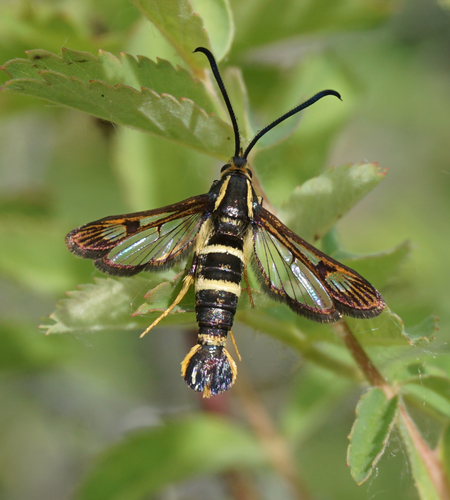
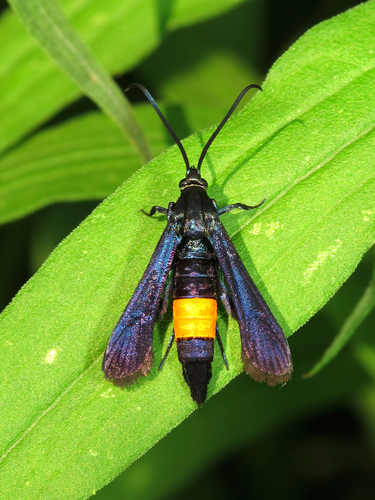
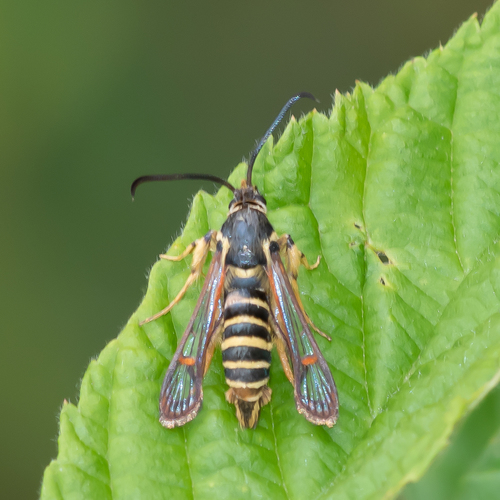
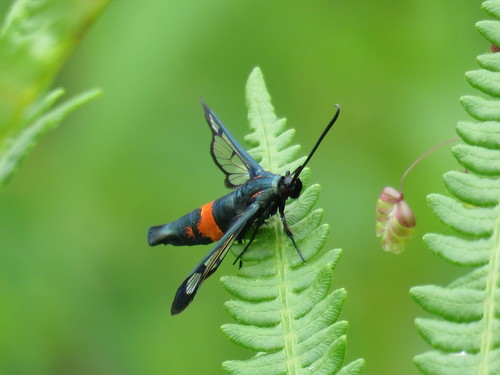
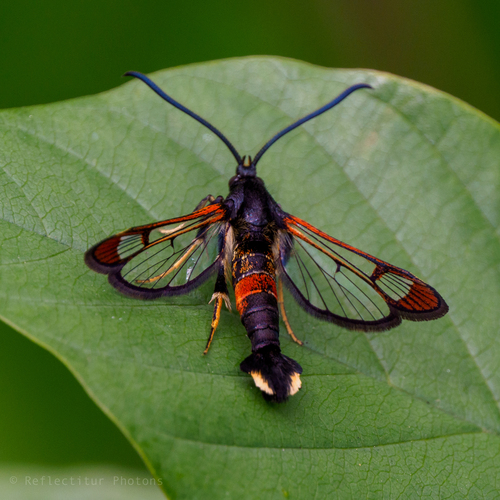
This species, Synanthedon formicaeformis (Esper, 1783), has the following life history and morphological characteristics. Eggs are laid between leaf and stem axils, in bark crevices, or on stump edges of Salix (willow) species, from the end of May to late July. Larvae feed internally inside the stems of multiple Salix species, including Salix viminalis. As documented by Heath and Emmet (1985), larvae produce very few external signs of their presence, other than slight browning; frass may be visible at the edge of a broken stem. Larvae feed between the wood and bark, and can be found in their tunnels if the bark is peeled back. When galls form, they may be pear-shaped, or what has been described as a "peculiar shape" where the diameter of the stem above the gall is larger than the diameter below it, and this size difference continues for some distance along the stem. These galls can look similar to galls formed by the sallow clearwing, Synanthedon flaviventris. The pupa is 12–14 mm long and does not spin a cocoon. Adult emergence holes have a diameter of approximately 2.5 mm, and before pupation the opening can be hidden by a thin cap. The shed pupal exoskeleton (exuviae) can remain sticking out of the emergence hole for a long time after emergence. The adult wingspan ranges from 17–19 mm. Adult wings are clear, with scales only present on the wing veins, the discal area, and the wing edges. The edges of the forewings are reddish, and the wing fringes are brownish. The discal stain is crescent-shaped, coloured olive or reddish brown, and stretches from the front to the back edge of the wing. The hindwings have a narrow dark edge and a small black-brown discal stain. The antennae, head, thorax, and abdomen are shiny blue-black. A red ring is present on both the fourth and fifth abdominal segments; sometimes the sixth segment also has a reddish colour. The hind tufts are distinctly fan-shaped, blue-black overall, and clear yellowish-white along the sides. Synanthedon formicaeformis is somewhat similar in appearance to Pyropteron chrysidiformis. Adults fly from May to July, and at higher elevations they may remain on the wing until August. They are most active during sunny weather, and visit the flowers of a range of plant species, including elderberry (Sambucus nigra), wild marjoram (Origanum vulgare), ragwort (Jacobaea vulgaris), common privet (Ligustrum vulgare), and red raspberry (Rubus idaeus).