About Synallaxis azarae Orbigny, 1835
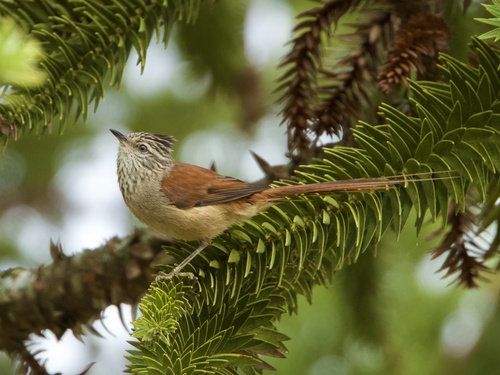
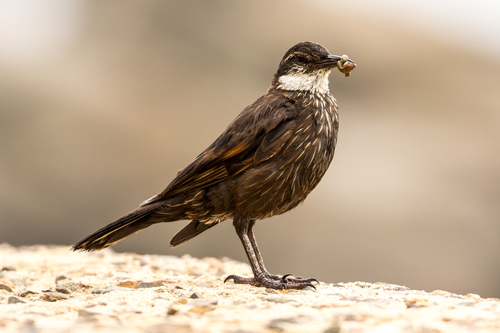
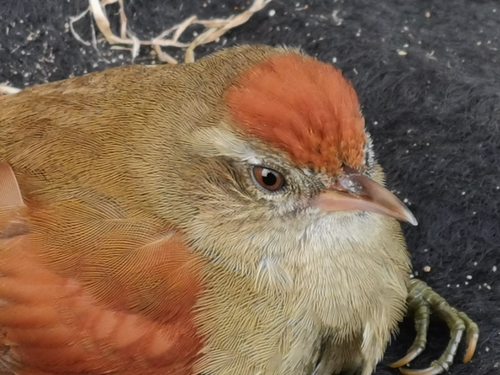
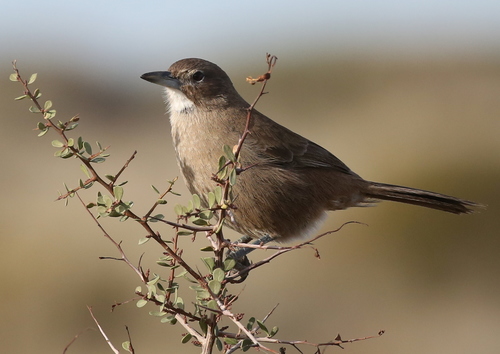
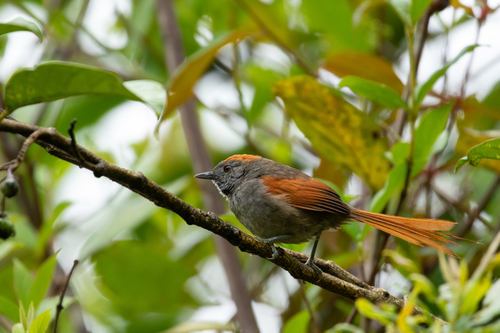
Azara's spinetail (scientific name Synallaxis azarae Orbigny, 1835) measures 15 to 18 cm (5.9 to 7.1 in) long and weighs 12 to 18 g (0.42 to 0.63 oz). The sexes share identical plumage. Adults of the nominate subspecies S. a. azarae have a brownish gray face with a slightly paler supercilium. Their forehead and forecrown are dark grayish brown, their hindcrown and nape are dark rufous, and their back, rump, and uppertail coverts are rich olive-brown. Their wings are mostly rufous-chestnut, with dark brownish tips on the flight feathers. Their tail is dull chestnut-brown; it is graduated, and the feathers have somewhat pointed tips. Their chin and the edges of their throat are pale grayish with darker feather tips; the center of their throat is sooty black with pale feather edges. Their breast is dark brownish gray, their belly is paler and grayer with faint mottling, and their flanks and undertail coverts are browner than the breast and belly. Their iris ranges from reddish brown to chestnut, their maxilla is black to dark gray, their mandible is gray or blue-gray (sometimes with a blackish base or tip), and their legs and feet are olive-gray to grayish green. Juveniles have a brown crown and back, an indistinct throat patch, and a pale brown to ochraceous wash on their underparts. The other subspecies differ from the nominate and each other in the following ways: S. a. elegantior is paler than the nominate, with a white spot on the lores, a fainter supercilium, and more fulvous flanks. S. a. media is paler than elegantior, with an even fainter supercilium, smaller loral spot, grayer chest, and paler, more olivaceous flanks. S. a. ochracea is paler than the nominate, especially on the crown and wing coverts, with a more buffy brown back, very pale underparts, and an ochraceous tinge to the flanks. S. a. fruticicola is lighter than the nominate but darker than ochracea. S. a. infumata is similar to the nominate, with more gray on the forehead and brighter rufous wing coverts. S. a. urubambae is similar to the nominate, but has a darker olivaceous gray-tinged tail, brighter wing coverts, and dull rufous edges on the flight feathers. S. a. samaipatae is paler than the nominate, with faint rufous edges on the forehead feathers, a buffish supercilium, and medium gray face and breast. S. a. superciliosa is paler than the nominate, with a more prominent buff supercilium, and light brown underparts with a whitish belly. The subspecies of Azara's spinetail have the following distribution: S. a. elegantior is found in Colombia's Eastern Andes and western Venezuela. S. a. media occurs in Colombia's Central and Western Andes, and extends south through Ecuador's Andes to Cotopaxi Province on the western slope and Zamora-Chinchipe Province on the eastern slope. S. a. ochracea inhabits the Andes of southwestern Ecuador from Guayas and Chimborazo provinces south into northwestern Peru as far as the Department of Lambayeque. S. a. fruticicola is found in northern Peru, in the Marañón River valley between the departments of Cajamarca and La Libertad. S. a. infumata occurs in the Andes of northern and central Peru between the departments of Amazonas and Junín. S. a. urubambae is found in the Department of Cuzco in southern Peru. S. a. azarae ranges across the Andes from the Department of Puno in southeastern Peru into central Bolivia as far as northwestern Santa Cruz Department. S. a. samaipatae is found in the Andes of southern Bolivia from Santa Cruz to Tarija Department. S. a. superciliosa inhabits the Andes of northwestern Argentina between the provinces of Jujuy and Catamarca. Azara's spinetail lives in a variety of humid and drier semi-open landscapes, including montane evergreen forest edges, secondary forest, cloudforest edges, elfin forest edges, bushy pastures, roadsides, riparian thickets, and semi-deciduous and deciduous woodlands in Argentina. It typically stays in dense vegetation close to the ground. Across most of its range, it occurs at elevations between 1,500 and 3,500 m (4,900 and 11,500 ft). In Bolivia and Argentina it occurs at lower elevations, mostly between 600 and 1,600 m (2,000 and 5,200 ft). In Ecuador it occurs locally as low as 900 m (3,000 ft) or lower, and in Colombia it descends to 1,200 m (3,900 ft).