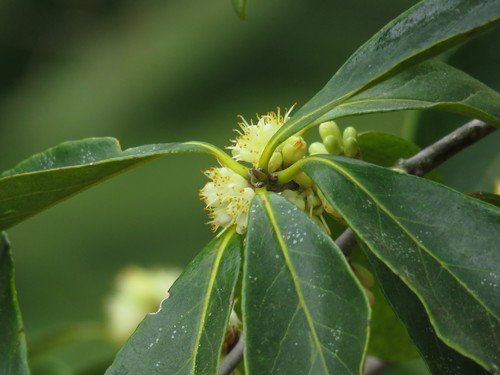
About Symplocos tinctoria (L.) L'Hér.
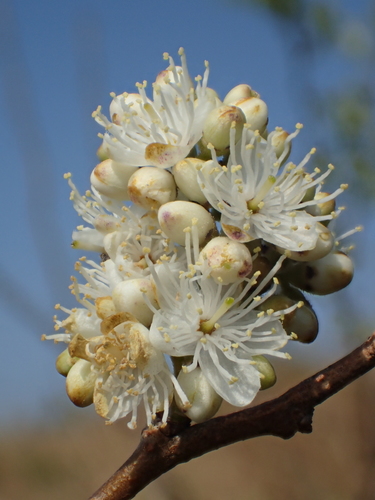
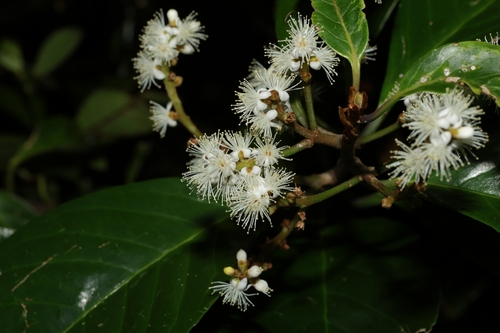
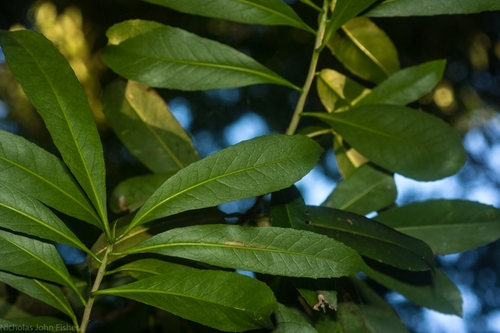
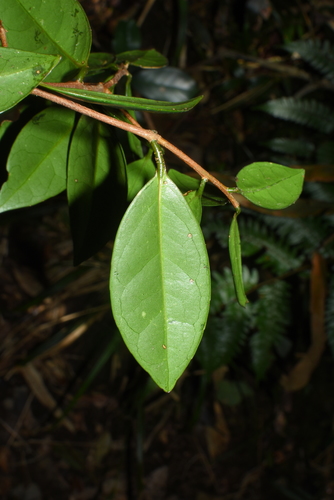
Symplocos tinctoria, commonly called common sweetleaf, horse-sugar, or yellowwood, grows as either a deciduous or evergreen shrub or tree. It can be identified by its chambered twig pith, non-aromatic foliage when bruised, and leaves that are finely hairy on the underside. It reaches up to 17 m tall and up to 36 cm in diameter at breast height. The largest first-year twigs measure less than 3 mm across; terminal buds have an acute tip, and their bud scales have ciliate margins. Leaves are 7–15 cm long, with entire margins, or occasionally bearing some teeth on the apical half. The leaves have a sweet taste, which may become faint in older leaves. This species is easy to spot when in flower: flowers open before new leaves emerge, are fragrant, and grow in clusters from the leaf axils of the previous year’s growth, or from just above leaf scars if the old leaves have fallen. Petals range from creamy yellow to yellow, and each flower has one pistil. Fruits are nearly cylindrical to ellipsoid drupes, 8–12 mm long, with thin pulp and a hard seed-containing stone that holds one seed. The tip of the fruit usually retains parts of the sepals. Browsing wildlife readily eat this species’ foliage. A yellow dye can be produced from the bark and leaves. It flowers from March to May. Symplocos tinctoria is native to the southern and eastern United States, ranging from Oklahoma east to Florida and north to Maryland. Plants are occasional, typically growing scattered rather than in grouped stands, which are uncommon. It inhabits thin to dense woodlands on slopes and bluffs, broad-leaf forests on sandy soils, stream borders, and stable dunes. It is the only member of the genus Symplocos found in North America. In addition to being relished by browsing wildlife, the branches of Symplocos tinctoria are parasitized by galls formed by Exobasidium symploci, which look very similar to the plant’s own fruits. A yellow dye was historically produced from this plant’s bark and leaves, and early American settlers used the bark as a tonic.