About Symphyotrichum spathulatum (Lindl.) G.L.Nesom
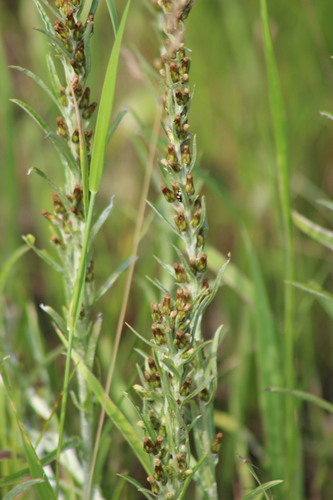
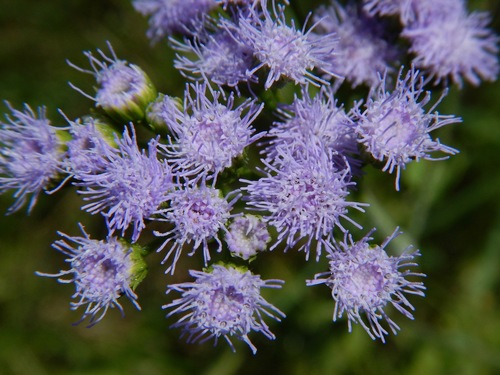
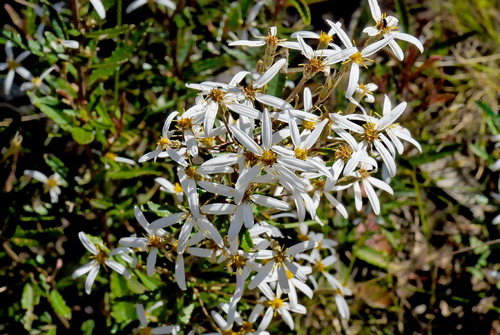
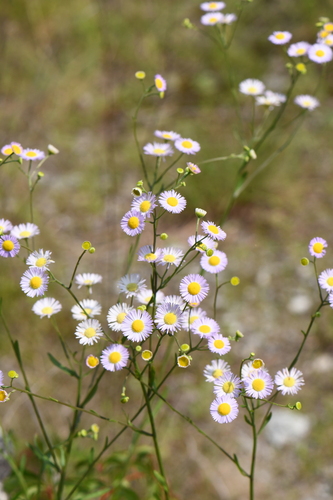
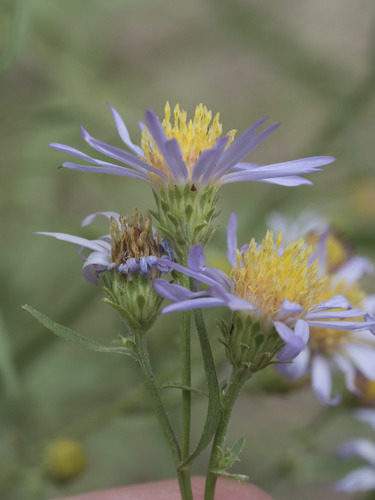
Symphyotrichum spathulatum is a colony-forming perennial that blooms in July and August. It typically grows 1 to 5 hairless or mostly hairless stems from a long rhizome, reaching 20 to 80 centimeters (8 to 31 inches) in total height. Its leaves are thin, entire, with little to no hair, and measure 5 to 15 centimeters (2 to 6 inches) long. Lower and basal leaves are linear, elliptical, narrow, and sometimes obovate, while upper leaves are shorter at 3 to 6 centimeters (1+1⁄8 to 2+3⁄8 inches). Flower heads are arranged in corymbiform to paniculiform arrays with minimal branching. The involucres are bell-shaped, 5–10 millimeters (1⁄5–2⁄5 inch) long, with phyllaries arranged in 3–5 series. Each flower head holds 15–40 violet ray florets, which are 9–15 millimeters (7⁄20–3⁄5 inch) long and 1–2 millimeters (1⁄20–1⁄10 inch) wide. These ray florets surround a central flower head made of 30–80, sometimes up to 100, yellow disk florets. Its seeds are brown, hairy cypselae 2.5–3.5 mm (1⁄10–3⁄20 in) long with around 4 nerves, attached to white pappi that are 5–7 millimeters (1⁄5–3⁄10 inch) long.
This species is native to western North America, occurring in western United States, western Canada, and northwestern Mexico. In Canada, it is native to British Columbia and Alberta. In the United States, it ranges from Washington state east to Montana, south to New Mexico, west to California, and north back to Oregon, with no recorded presence in Arizona. In Mexico, it is native to the states that border the Gulf of California. It grows at elevations from 1,200–2,900 meters (3,900–9,500 feet) or lower, in meadows on mountain slopes, and open aspen and coniferous forests.
The variety S. spathulatum var. intermedium is native to British Columbia, California, Idaho, Nevada, Oregon, and Washington state, and it only occurs occasionally in California and Nevada. It grows at 1,200–2,200 m (3,900–7,200 ft) in grasslands, mountain slope meadows, and open coniferous forests. The variety S. spathulatum var. yosemitanum is restricted to the range from southern Oregon to the Sierra Nevada of California. It can be found at 1,200–2,200 m (3,900–7,200 ft) in oak woodlands and coniferous forests.