About Symphyotrichum georgianum (Alexander ex Small) G.L.Nesom
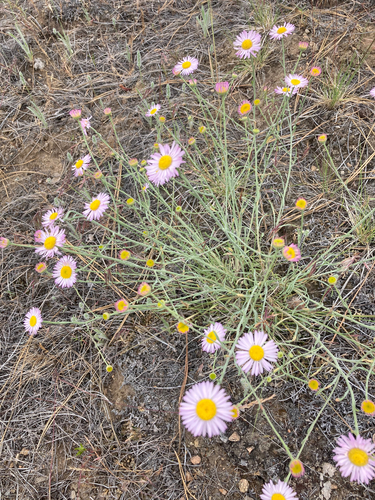
Georgia aster (Symphyotrichum georgianum) is a robust, rhizomatous, herbaceous perennial plant that forms colonies of woody stems reaching up to 1 meter (3 feet 3 inches) in height. Its thick, dark green leaves grow up to 7 centimeters (2+3⁄4 inches) long and 2 centimeters (4⁄5 inch) wide, and are oblong to lance-shaped with either smooth or serrated margins. Flower heads grow on rough-haired peduncles, and the bracts of these heads are linear to lance-shaped. Stems, leaves, and some parts of the flower heads are covered in tiny stalked glands called stipitate glands. Flower heads are relatively large, reaching 5–6 centimeters (2–2+3⁄8 inches) across. Each ray floret is up to 2 centimeters (4⁄5 inch) long, and colored purple, ranging from dark purple to lavender violet to dark reddish purple. The disk florets at the center of the flower head range from white to purplish. This species blooms in October and November. Symphyotrichum georgianum is native to the southeastern United States, where it has been recorded from Alabama, Florida, Georgia, North Carolina, and South Carolina. As of 2013, it may no longer exist (be extirpated) in Florida. It grows in oak-pine woodlands. The local area it occupies was once entirely covered in post oak-savanna, and this species was part of that ecosystem. This type of plant community relies on natural disturbance such as wildfire, and it has been largely destroyed or degraded by modern fire suppression and the removal of certain large grazing mammals. Because of this, Georgia aster is a relict species of this historic ecosystem, and only grows in remaining intact woodlands.